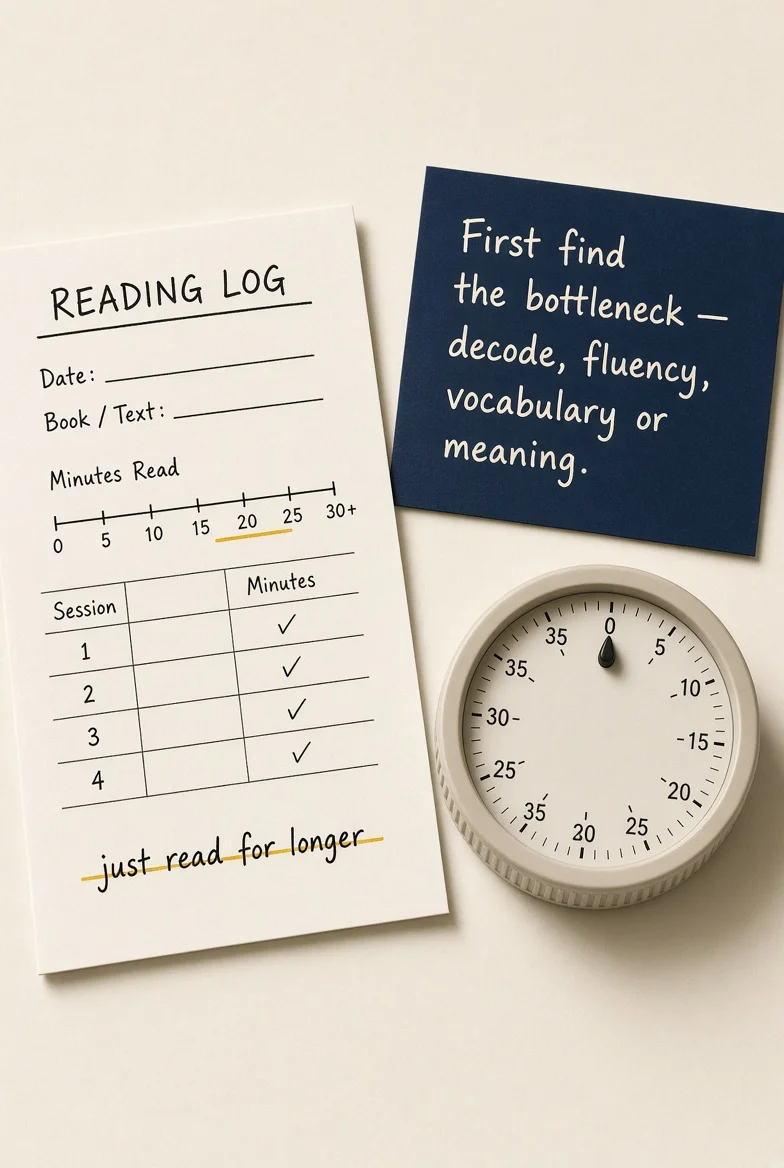
When a parent says, “My child is behind in reading,” the first thing we need to know is what part of reading is difficult.
Reading is not one single skill.
A child may struggle to recognise or decode words accurately. Another may read the words correctly but so slowly that understanding is lost. Another may sound fluent when reading aloud but be unable to explain what the text means.
Those children may all appear to be “behind in reading”, but they do not need identical teaching.
The most useful first step is therefore to move from a broad concern to a specific reading difficulty.
Once we know where the reading process begins to break down, the support can become much more targeted.
Quick Answer: What Should I Do If My Child Is Behind in Reading?
- Speak to your child’s school and ask which aspect of reading is causing concern.
- Look at whether the difficulty is recognising words, reading fluently, understanding vocabulary or comprehending the text.
- Listen to your child read an appropriate text, but also ask questions about what it means.
- Check whether they can explain an answer using evidence from the text.
- Keep reading practice manageable and regular rather than making it a source of conflict.
- Use books and texts at an appropriate level while still exposing your child to rich spoken language and vocabulary.
- Seek more targeted support if the difficulty is persistent or significantly affecting learning.
Avoid reducing the problem to a label such as “lazy reader” or “not academic”. A specific description gives teachers and parents something they can actually act on.
The Skinat Reading Diagnostic Ladder
A useful way to think about reading is as a connected ladder. Difficulty lower down can affect everything above it.
1. Decode: Can the child recognise words accurately and use appropriate strategies when a word is unfamiliar?
2. Fluency: Can they read with enough accuracy, pace and phrasing to hold the meaning of the sentence or paragraph?
3. Vocabulary: Do they understand enough of the words and phrases to access the text?
4. Understand: Can they retrieve information, follow ideas and make sensible inferences?
5. Explain: Can they support an interpretation with relevant evidence and explain their thinking?
6. Transfer: Can they use the same reading skill on a different text or unfamiliar question?

The point is not to diagnose a medical or learning condition. It is to identify the academic reading skill that needs closer attention.
DECODE → FLUENCY → VOCABULARY → UNDERSTAND → EXPLAIN → TRANSFER
1. Is Your Child Struggling to Read the Words?
If a child frequently guesses unfamiliar words, loses their place, omits parts of words or needs substantial help to work out age-appropriate text, word recognition and decoding may need attention.
For younger readers, the school can explain how the child is progressing with the reading approach used in class and what practice is appropriate at home.
Parents should avoid turning every reading session into a test. Correcting every word immediately can make it difficult to see which strategies the child is using independently.
If you are concerned about persistent decoding difficulty, discuss it with the school so that teaching and any additional support can be coordinated.
2. Can Your Child Read the Words but Only Very Slowly?
Reading accuracy and reading fluency are related but different.
A child may eventually read every word correctly but use so much effort that they lose the meaning of the sentence by the time they reach the end.
Fluency includes accuracy, appropriate pace and phrasing. It is not a competition to read as quickly as possible.
Repeated reading of appropriately chosen short passages, modelling fluent reading and discussing punctuation or phrasing can sometimes be useful, but the right approach depends on why fluency is difficult.
3. Could Vocabulary Be Blocking Understanding?
Sometimes a child can decode a sentence accurately but does not know enough of the vocabulary to understand what it means.
This becomes increasingly important as school texts contain more subject-specific and abstract language.
When your child meets an unfamiliar word, ask whether the surrounding sentence provides clues. Discuss the likely meaning, related words and how the word changes the meaning of the sentence.
Vocabulary grows through reading, conversation, explicit teaching and repeated encounters with words in meaningful contexts.
4. Your Child Reads Fluently—but Do They Understand?
Fluent oral reading can sometimes hide weak comprehension.
After a short section, ask your child to tell you what happened or explain the main idea in their own words.
Then move beyond direct recall:
- Why do you think the character did that?
- What makes you think that?
- What does this word suggest here?
- What changed between the beginning and end of the paragraph?
- Which detail is most important and why?
If the child can read the passage confidently but cannot answer these kinds of questions, comprehension may need more attention than fluency.
5. Can Your Child Find Evidence but Not Explain It?
As children progress through school, reading increasingly requires explanation rather than simply finding information.
A learner may correctly select a quotation or detail but struggle to explain how it supports their answer.
A useful teaching sequence is:
- Answer the question.
- Find the evidence.
- Explain what the evidence shows.
- Connect the explanation back to the question.
This develops a habit that later supports more demanding comprehension and analytical reading.
A Correct Answer Does Not Always Mean Reading Is Secure
A child may answer a direct question correctly because the exact words appear in the text.
Change the question so that they must infer, summarise or connect information from different parts of the passage and the difficulty may become visible.
That is useful diagnostic information.
The goal is not to catch a child out. It is to understand the level at which they can currently work independently.
Try the Skinat Three-Text Transfer Check
If you want to know whether a reading skill is becoming secure, avoid repeating only one worksheet format.
- Text 1 — Familiar: practise the skill with clear teacher or parent support.
- Text 2 — Varied: use a different text with less prompting.
- Text 3 — Transfer: use an unfamiliar text and ask the child to identify and apply the same reading skill independently.

If performance falls sharply at the third stage, the child may understand the skill in a familiar context but not yet transfer it independently.
How Far Behind Is My Child in Reading?
Parents understandably want a clear number, age or level.
School assessments can provide useful information, but one score should not be interpreted in isolation.
Ask the school what the result measures, how reliable it is for the decision you are making, which reading skills appear secure and which need development.
A reading-age score, for example, should not be treated as a complete description of everything a child can or cannot do in reading.
Teacher observations, classwork, assessment evidence and the child’s response to teaching all add useful context.
What Parents Can Do at Home
- Read regularly in short, manageable sessions.
- Choose material that is accessible enough for successful reading while still offering interesting ideas and vocabulary.
- Read aloud to your child as well as listening to them read, especially when the ideas are richer than the text they can yet read independently.
- Talk about the meaning of the text.
- Ask your child to explain answers rather than turning reading into rapid-fire questioning.
- Discuss unfamiliar vocabulary in context.
- Revisit favourite texts; rereading can support fluency and deeper understanding.
- Keep a note of recurring difficulties to discuss with the school.
- Stop before frustration turns the entire reading experience into a battle.
Reading at home should support learning, not become a daily judgement of the child.
What Should I Avoid?
- Comparing your child publicly with siblings or classmates.
- Describing them as lazy, slow or “not a reader”.
- Choosing books only because the cover says they match a particular age.
- Making the child read texts that are so difficult that almost every sentence requires correction.
- Focusing only on speed.
- Assuming that more worksheets will solve a difficulty that has not been identified.
- Diagnosing a learning condition from internet checklists.
When Should I Speak to the School?
Speak to the school if you notice a persistent difficulty, your child is becoming distressed about reading, or you are unsure how their reading compares with classroom expectations.
Useful questions include:
- Which aspect of reading is causing concern?
- Is word reading, fluency, vocabulary or comprehension the main issue?
- What does recent assessment evidence show?
- What support is already being provided?
- What should we practise at home?
- How will progress be reviewed?
- Is there any wider learning need the school is already investigating or supporting?
This keeps home support connected to what the child is learning rather than creating a separate programme based on guesswork.
Could a Reading Difficulty Affect Other Subjects?
Yes. As children get older, reading becomes one of the main ways they access the wider curriculum.
A pupil who struggles to interpret written information may find word problems in Maths, explanations in Science or source material in Humanities harder even when they understand the underlying subject.
That is why persistent reading difficulty is worth understanding early.
Does My Child Need an English Tutor for Reading?
Not every child who is behind in reading needs private tuition.
Additional teaching may be worth considering when the difficulty is persistent, the child needs more individual modelling or practice, progress remains limited despite existing support, or reading difficulty is beginning to affect confidence and wider learning.
The tutor should be able to explain what aspect of reading they are teaching and why.
A generic promise to “improve reading” is less useful than a plan based on the child’s actual starting point.
See Our latest guide: How to Know If Your Child Needs an English Tutor
What About Dyslexia or Other Additional Needs?
Persistent reading difficulty can have many possible explanations. Academic symptoms alone are not enough to diagnose dyslexia or another condition.
If you or the school have broader concerns, discuss the appropriate next steps with the professionals responsible for the child’s education and assessment.
Tuition can adapt teaching to a learner’s needs, but a tutor should not present ordinary tuition as a substitute for formal assessment or specialist provision where that is required.
Explore our service: SEND-Friendly Tuition / Online Tutor for Dyslexia UK
How Skinat Tuition Supports Learners Who Are Struggling With Reading
Skinat Tuition provides personalised online English tuition through qualified UK teachers.
We begin by trying to understand what the learner can already do and where the reading process becomes difficult.
Depending on the learner, teaching may focus on comprehension, vocabulary, fluency, evidence, explanation, written response or another identified English skill.
We do not assume that every child described as “behind in reading” needs the same lesson sequence.
Our approach is:
DIAGNOSE → TEACH → PRACTISE
Diagnose the academic difficulty. Teach the relevant skill explicitly. Practise it in increasingly varied contexts so that the learner can use it more independently.
Explore our services: Primary Tuition • Online English Tutor UK • How to Know If Your Child Needs an English Tutor • SEND-Friendly Tuition • Programmes Hub
A UK-Wide Note for Parents
Reading expectations, curriculum terminology and assessment arrangements vary across the UK’s education systems.
This article provides general parent guidance rather than a nation-specific attainment judgement. Families should use their child’s school feedback and the curriculum relevant to their location.
Skinat Tuition provides UK-wide online support and should match teaching to the learner’s actual stage and educational context.
Frequently Asked Questions
Why is my child behind in reading?
There is no single cause. The difficulty may involve word reading, fluency, vocabulary, comprehension, language, confidence or a combination of factors. Start by asking the school which aspect of reading is causing concern.
My child can read aloud but cannot answer questions. What does that mean?
It may indicate that word reading is stronger than comprehension. Check whether the child understands vocabulary, can retrieve information, infer meaning and explain answers using evidence.
Should I make my child read every day?
Regular reading can be useful, but the experience should be manageable and purposeful. Short, positive sessions are often more sustainable than long sessions that repeatedly end in frustration.
Should I correct every word my child reads incorrectly?
Not necessarily. Some correction is useful, but constant interruption can prevent you from seeing the strategies the child uses independently and can disrupt meaning. Follow guidance from the child’s school for their stage of reading development.
Can reading difficulties affect Maths?
Yes. A learner may understand a mathematical concept but struggle to interpret a word problem or written instruction. Reading and language demands can therefore influence performance in several subjects.
Does being behind in reading mean my child has dyslexia?
No. Reading difficulty alone does not establish a diagnosis. If there are persistent concerns, speak to the school and follow appropriate professional assessment routes.
Can Skinat Tuition help a child who is struggling with reading?
Skinat Tuition can provide personalised online English support, subject to appropriate teacher availability. Teaching should be based on the learner’s identified academic needs and should complement school support.
Conclusion: Find the Point Where Reading Breaks Down
My child is behind in reading” is an important concern, but it is only the beginning of the diagnosis.
Can the child decode the words? Can they read fluently enough to retain meaning? Do they understand the vocabulary? Can they infer, explain and use evidence? Can they transfer the same skill to a different text?
Those questions turn a broad worry into teachable information.
Once the difficulty becomes specific, parents, schools and tutors can make better decisions about what the learner needs next.
At Skinat Tuition, our qualified UK teachers use personalised teaching to identify academic gaps, teach the relevant skills and help learners practise towards greater independence.
Your child’s first lesson is free, with no obligation to continue.
Discover more from Online Tutoring UK | Qualified Teachers | Skinat Tuition
Subscribe to get the latest posts sent to your email.