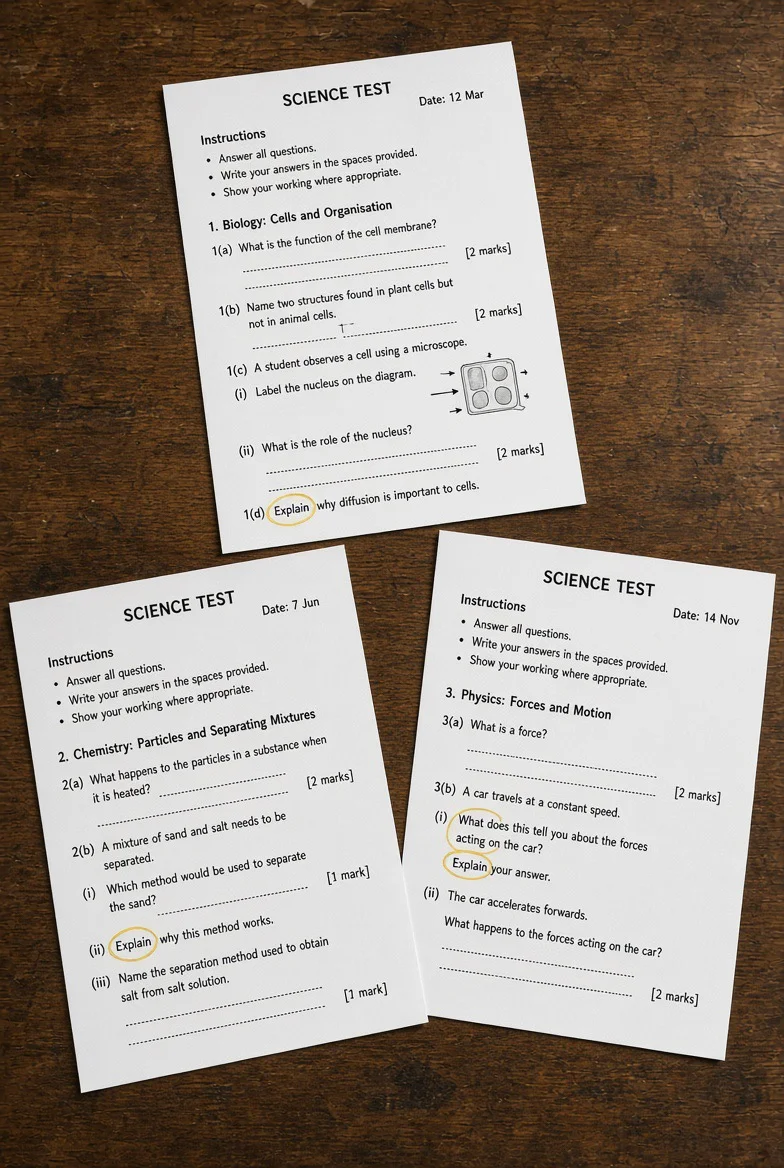
My child finds Science hard” sounds like one problem, but Science difficulties can come from very different places.
A learner may remember facts but not understand the concept. Another may understand the science verbally but struggle with equations or graphs. Another may know the topic at home but fail to recognise which knowledge an unfamiliar exam question requires.
That distinction matters because simply doing more Science questions will not necessarily solve the underlying difficulty.
The first step is to identify where the learning process is breaking down.
Quick Answer: What Should I Do If My Child Is Struggling With Science?
- Ask the school which Science topics and skills are causing the greatest difficulty.
- Separate factual recall from conceptual understanding.
- Check whether scientific vocabulary is blocking comprehension.
- Look for Maths skills that may be affecting Physics, Chemistry or data questions.
- Ask your child to explain a concept without copying the textbook.
- Use unfamiliar questions to check whether knowledge can be applied.
- Review practical, graph and data-handling skills as well as written knowledge.
- For exam-age learners, classify lost marks rather than simply repeating whole papers.
- Consider targeted additional support if the same gaps persist.
The Skinat Science Diagnostic Framework
1. Recall: Can the learner remember the relevant facts, definitions, equations or processes?
2. Understand: Can they explain what the scientific idea actually means?
3. Connect: Can they link the idea to related concepts rather than learning facts in isolation?
4. Calculate: Can they use the necessary mathematical skills, units, formulae and data accurately?
5. Apply: Can they recognise and use the science in an unfamiliar context?
6. Explain: Can they construct a precise scientific explanation using evidence and appropriate vocabulary?
RECALL → UNDERSTAND → CONNECT → CALCULATE → APPLY → EXPLAIN
1. Is the Problem Scientific Knowledge—or Understanding?
A child can memorise a definition and still not understand the idea behind it.
For example, recalling a statement about diffusion is different from being able to predict what will happen in a new situation and explain why.
After revision, ask the learner to explain the concept in their own words, draw or interpret a representation, and answer a changed example. If the knowledge disappears when the wording changes, understanding may need strengthening.
2. Is Scientific Vocabulary Getting in the Way?
Science contains a large amount of specialist language. Words such as “mass”, “weight”, “power”, “energy”, “cell” or “solution” can also have everyday meanings, which can create confusion.
A learner may understand part of a topic but lose marks because their explanation is too vague or because they misunderstand the terminology in the question.
- Build a small topic vocabulary bank.
- Use each term in a scientifically accurate sentence.
- Compare easily confused terms.
- Ask the child to explain a term without simply reciting the textbook definition.
- Revisit vocabulary across several lessons rather than learning it once.
3. Could Maths Be the Hidden Science Problem?
Science and Maths overlap substantially, particularly as learners progress through secondary school.
A pupil may understand the scientific principle but struggle with rearranging formulae, percentages, ratios, standard form, graphs, unit conversions or proportional reasoning.
When a numerical Science question goes wrong, check the first incorrect step. Was the science misunderstood, was the formula chosen incorrectly, or did the mathematical execution fail?
This distinction prevents a Maths gap from being mistaken for a Science misconception.
4. Can Your Child Read and Interpret Scientific Questions?
Science questions often combine subject knowledge with reading demands.
The learner may need to identify variables, interpret a practical method, extract information from a graph, distinguish command words or ignore irrelevant context.
Before answering, encourage the learner to identify:
- What topic or idea is being tested?
- What information has been given?
- What does the command word require?
- Is data, a diagram or a graph relevant?
- What scientific vocabulary should appear in the answer?

5. Does Your Child Know the Topic but Struggle With Application?
This is a common difficulty, particularly in assessment questions.
A learner revises a topic successfully and answers familiar questions, but becomes stuck when the same science is placed inside a new experiment or real-world context.
That is why effective revision should not consist only of rereading notes or repeating identical questions.
After teaching a concept, vary the context and ask the learner to identify which scientific idea still applies.
The Skinat Science Transfer Test
- Direct: Can the learner answer a straightforward knowledge question?
- Explain: Can they explain why the scientific idea works?
- Changed Context: Can they use it in a different experiment, diagram or scenario?
- Independent Transfer: Can they identify the relevant science without being told the topic?
If performance drops only when the context changes, the learner may know the content but not yet be able to transfer it.
6. Practical Science: Can They Reason About Experiments?
Science is not only a collection of facts.
Learners may need to identify variables, understand methods, interpret results, evaluate evidence, suggest improvements and reason about uncertainty or reliability at an appropriate level.
A child who memorises practical steps without understanding why each step is used may struggle when an assessment changes the method.
Ask questions such as: “What are we changing?”, “What are we measuring?”, What should stay the same?” and “Why would this improve the evidence?
7. Can Your Child Interpret Graphs, Tables and Data?
Data questions combine reading, mathematical and scientific reasoning.
Check whether the learner can read scales accurately, identify trends, compare values, recognise anomalies where appropriate and use data as evidence for a conclusion.
If they can describe a graph but cannot explain it scientifically, the difficulty may be connecting data back to the underlying concept.
8. Biology, Chemistry or Physics: Is One Area Causing Most of the Difficulty?
Science” can hide a very uneven profile.
A learner may be confident in Biology but find quantitative Chemistry difficult. Another may enjoy Chemistry but struggle with the mathematical demands of Physics.
Use school assessments and topic-level evidence to determine whether the problem is broad or concentrated in one discipline.
This matters when deciding what additional teaching is actually needed.
9. For GCSE Learners: Stop Looking Only at the Total Mark
A total paper score tells you how many marks were gained. It does not automatically tell you why marks were lost.
After a paper, classify a small sample of errors:
- Knowledge gap.
- Misconception.
- Scientific vocabulary.
- Maths/calculation.
- Graph or data interpretation.
- Practical-method reasoning.
- Command-word or question-reading error.
- Application/transfer.
- Incomplete explanation.
This turns a mock paper into a teaching plan rather than simply another grade.
What If My Child Says They Hate Science?
Dislike can sometimes develop after repeated confusion or low assessment results.
Start by identifying whether the learner dislikes all Science or a particular part of it. A child who says “I hate Physics” may actually be struggling with equations. Another may dislike Biology because the amount of terminology feels overwhelming.
Confidence is more likely to improve when the source of difficulty becomes specific and the learner experiences genuine progress.
How Parents Can Support Science at Home
- Ask your child to teach you one concept in their own words.
- Use diagrams and simple representations where they improve understanding.
- Connect new vocabulary to previously learned ideas.
- Separate Science errors from Maths errors.
- Use short retrieval practice, then move to explanation and application.
- Discuss graphs, tables and data rather than only factual questions.
- Use school specifications or teacher guidance for exam-age learners.
- Keep an error log of recurring misconceptions and question types.
Should My Child Just Do More Past Papers?
Past papers can be extremely useful for exam preparation, but their value depends on what happens after the paper.
If the learner repeatedly completes papers without diagnosing errors, the same weaknesses may simply be rehearsed.
A better sequence is:
DIAGNOSE → RETEACH → TARGETED PRACTICE → NEW APPLICATION → PAPER CHECK
Past papers are then used to test whether learning transfers under assessment conditions.
When Might a Science Tutor Help?
Not every difficult Science topic requires private tuition.
Additional support may be useful when important gaps persist, the learner needs more individual explanation, mathematical or vocabulary barriers are repeatedly affecting Science, exam performance remains below their demonstrated understanding, or confidence is deteriorating.
A tutor should be able to explain whether the priority is Biology, Chemistry, Physics, scientific skills, Maths within Science, or exam application.
Generic “more Science practice” is not a diagnosis.
How Skinat Tuition Approaches Science Support
Skinat Tuition provides personalised online Science tuition through qualified UK teachers.
We want to understand the learner’s stage, curriculum or qualification, recent assessment evidence, strongest and weakest Science areas, and the particular type of error that is limiting progress.
Teaching can then focus on the relevant knowledge, concept, vocabulary, calculation, application or assessment skill.
Our core approach is:
DIAGNOSE → TEACH → PRACTISE
Then we check whether the learner can use the science independently when the context changes.
Learn more: Programmes Hub • Primary Tuition • Secondary Tuition • GCSE/IGCSE Tuition
A UK-Wide Note for Parents
Science curricula and qualifications differ across England, Wales, Scotland and Northern Ireland.
GCSE, IGCSE, National 5 and other qualifications should not be treated as interchangeable. Exam-age tuition should match the learner’s actual course, specification and awarding body where relevant.
Skinat Tuition provides UK-wide online support, so the educational context should be established before teaching is planned.
Frequently Asked Questions
Why is my child struggling with Science?
The difficulty may involve factual knowledge, conceptual understanding, scientific vocabulary, Maths, practical reasoning, data interpretation, application or exam technique. Start by identifying which type of difficulty appears repeatedly.
How can I help my child get better at Science?
Use short retrieval practice, ask the learner to explain concepts in their own words, connect related ideas, practise calculations where relevant and then apply the science in unfamiliar questions.
Why does my child know Science at home but do badly in tests?
They may struggle with question interpretation, time pressure, application, command words, data or transferring knowledge into unfamiliar contexts. Analyse the paper by error type rather than looking only at the score.
Does my child need a Science tutor?
Possibly, if persistent gaps are not improving through current support and more individual explanation or targeted practice would help. The need should be based on evidence rather than one disappointing result.
Can Maths affect Science grades?
Yes. Maths skills are used in many Science questions, particularly at secondary level. It is important to distinguish a scientific misconception from a mathematical execution error.
Should my child revise Biology, Chemistry and Physics equally?
Not automatically. Revision should reflect the learner’s course and evidence of strengths and weaknesses. Topic-level assessment can help prioritise time.
Can Skinat Tuition help with Science?
Yes, subject to appropriate teacher availability. Skinat Tuition supports Science through qualified UK teachers and teaching should be matched to the learner’s stage, curriculum and identified needs.
Conclusion: 'Struggling With Science' Is the Start of the Diagnosis
A low Science mark does not tell us exactly what needs to be taught next.
Find the point where the process breaks: recall, understanding, connections, calculation, application or explanation.
Then target that specific weakness and test it again in a different context.
This is more useful than simply increasing the number of worksheets or past papers.
At Skinat Tuition, our qualified UK teachers use personalised teaching to diagnose gaps, teach the relevant Science and help learners practise towards greater independence.
Your child’s first lesson is free, with no obligation to continue.
Discover more from Online Tutoring UK | Qualified Teachers | Skinat Tuition
Subscribe to get the latest posts sent to your email.