Parents often ask what their child should be able to do in English before starting Year 7.
A useful answer needs to go beyond a checklist of grammar terms, spellings or books read.
Secondary English increasingly asks pupils to understand more demanding texts, infer meaning, discuss how language works, organise ideas, use evidence and write with greater independence.
A child can therefore appear to be doing well because they can read fluently or complete familiar grammar exercises, while still finding comprehension, explanation or independent writing difficult.
For pupils following the English national curriculum, Year 6 consolidates important Key Stage 2 reading and writing foundations before Key Stage 3. Schools may teach and sequence content differently, so this guide should be used alongside the child’s own school feedback.
The key question is not simply, Has my child covered Year 6 English?” It is, “Can my child understand, explain and communicate increasingly independently?
Quick Answer: The Main Year 6 English Skills to Check
- Reading age-appropriate texts with sufficient fluency to focus on meaning.
- Retrieving relevant information from a text.
- Making sensible inferences and supporting them with evidence.
- Explaining vocabulary and meaning in context.
- Summarising important ideas.
- Discussing how language choices contribute to meaning or effect at an age-appropriate level.
- Planning and organising writing for different purposes and audiences.
- Constructing clear sentences and paragraphs.
- Using vocabulary deliberately rather than simply trying to use “big words”.
- Applying spelling, punctuation and grammar with increasing control.
- Reviewing and improving writing.
- Explaining ideas and working with increasing independence.
The aim is not perfection in every area. It is to understand which foundations are secure and which may need strengthening before secondary expectations increase.
The Skinat Year 6 English Readiness Framework
1. Read: Can the learner read the text fluently enough to concentrate on meaning?
2. Understand: Can they retrieve information, infer meaning, understand vocabulary and follow the ideas in the text?
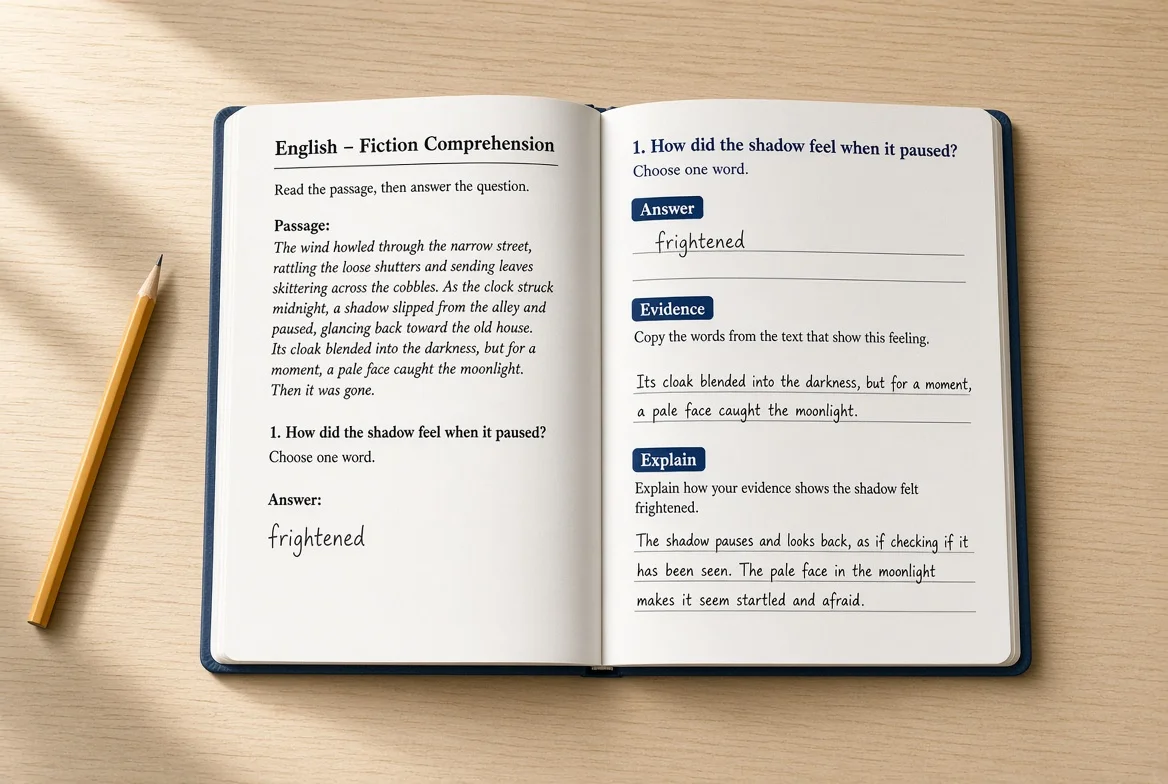
3. Explain: Can they support an interpretation with evidence and explain their thinking rather than give a one-word answer?
4. Write: Can they organise and communicate ideas appropriately for the task?
5. Edit: Can they reread work, notice weaknesses and make useful improvements to accuracy or expression?
6. Work independently: Can they begin, persist and apply feedback without constant adult prompting?
A pupil may be strong in several areas and still have one gap that becomes much more visible in Year 7.
READ → UNDERSTAND → EXPLAIN → WRITE → EDIT → INDEPENDENCE
1. Reading Fluency: Can Your Child Focus on Meaning?
Reading fluency matters because a learner who uses most of their attention decoding individual words has less capacity available for understanding the text.
Fluent reading does not mean reading as fast as possible. It means reading with sufficient accuracy, pace and expression to follow meaning.
If reading aloud remains effortful, or unfamiliar vocabulary repeatedly interrupts comprehension, this is worth discussing with the school before the transition to secondary school.
2. Reading Comprehension: Can They Understand More Than the Obvious?
By Year 6, pupils are expected to do more than locate a fact on the page.
They increasingly need to infer, summarise, explain vocabulary in context, identify relevant evidence and discuss how information or ideas are presented.
A useful parent check is to ask a question whose answer is not copied directly from one sentence.
- What does this suggest about the character?
- Which detail makes you think that?
- Why might the writer have chosen that word?
- What is the most important idea in this section?
- How has your view changed after reading the next paragraph?
If a child can read every word but cannot explain what the text implies, the issue is comprehension rather than basic decoding.
3. Vocabulary: Does Your Child Work Out Meaning in Context?
Secondary texts introduce increasingly unfamiliar vocabulary across English and other subjects.
Children do not need to know every word in advance. They benefit from strategies for working out likely meaning from the sentence, surrounding paragraph, word parts and wider context.
Vocabulary development is also about precision. A learner who can choose an accurate word for an idea often communicates more effectively than one who simply inserts complicated vocabulary without understanding it.
4. Can Your Child Explain an Answer Using Evidence?
One important transition skill is moving from an answer to a supported explanation.
For example, saying that a character is frightened is a starting point. A stronger response identifies evidence and explains how that evidence supports the interpretation.
This habit becomes increasingly important in secondary English, where pupils are expected to justify ideas and later analyse texts in greater depth.
Parents can encourage this by asking, “What in the text makes you think that?”
5. Writing: Can Your Child Organise Ideas for a Purpose?
Year 6 writing should not be judged only by handwriting, length or the number of ambitious words.
A stronger readiness question is whether the child can shape writing for a purpose and reader.
- Can they plan before writing?
- Can they organise ideas into a logical sequence?
- Can they use paragraphs meaningfully?
- Can they vary sentences where appropriate?
- Can they maintain an appropriate tone?
- Can they choose vocabulary that communicates precisely?
- Can they sustain a piece of writing rather than losing direction halfway through?
Secondary English will ask pupils to write in different forms and for different purposes. Organisation and control are therefore valuable foundations.
6. Spelling, Punctuation and Grammar: Accuracy Should Support Meaning
Technical accuracy matters because punctuation, grammar and spelling help a reader understand the writing.
Year 6 pupils following the English curriculum encounter a range of grammatical terminology and conventions, but knowing the name of a feature is not the same as using it effectively.
A child may identify a subordinate clause in an exercise yet struggle to construct clear sentences in their own writing.
The more useful readiness check is whether taught grammar and punctuation are transferring into independent writing.
7. Editing: Can Your Child Improve Their Own Work?
Editing is a powerful transition skill because secondary pupils are expected to take increasing responsibility for the quality of their work.
Ask the learner to reread a paragraph with one purpose at a time:
- Does every sentence make sense?
- Is anything missing?
- Could one word be more precise?
- Are sentence boundaries clear?
- Does the paragraph stay focused?
- Can any repetition be removed?
- Have obvious spelling or punctuation errors been corrected?

Editing should not become an exercise in an adult correcting everything. The aim is to teach the learner how to notice and improve their own work.
8. Independence: What Happens When the Adult Stops Prompting?
A child may produce excellent work when an adult supplies questions, sentence starters, vocabulary and reminders.
That support can be useful during learning. But readiness also depends on what happens when some of the scaffolding is removed.
Can the child begin independently? Can they decide what evidence to use? Can they continue after making a mistake? Can they use previous feedback without being reminded?
Secondary school places greater demands on these habits, so gradually reducing unnecessary prompting can be valuable.
A Correct Answer Does Not Always Show Secure Understanding
This principle applies to English as well as Maths.
A pupil may answer a comprehension question correctly because the wording closely matches the text. Change the question so that it requires inference, explanation or evidence and the response may become much less secure.
That does not mean the first answer was meaningless. It tells us the level at which understanding currently operates.
Good teaching therefore checks whether a learner can transfer reading and writing skills when the task becomes less familiar.
A Simple Parent Diagnostic: Direct → Explain → Transfer
You can learn more about a skill by checking it in three stages:
- Direct: Can your child answer a straightforward question about the text?
- Explain: Can they show the evidence and explain how it supports the answer?
- Transfer: Can they use the same reading skill on a different text or less familiar question?

If the first stage is secure but the third is difficult, the child may need more practice applying the skill rather than simply repeating direct questions.
What If My Child Is Below Expectations in Year 6 English?
Do not try to repair every possible weakness at once.
Start by identifying which area is having the greatest effect on other learning.
For example, weak comprehension can affect English, Science, History and even mathematical word problems. Difficulty organising sentences can interfere with writing across the curriculum. Limited vocabulary can make increasingly complex texts harder to access.
Speak to the school about the specific areas of concern and prioritise the skills that will unlock the greatest amount of future learning.
Should My Child Start GCSE English Work Before Year 7?
For most pupils, there is no need to turn Year 6 into early GCSE preparation.
Secure reading comprehension, vocabulary, writing, explanation, accuracy and independence are more useful foundations than prematurely memorising GCSE terminology or examination structures.
A child who is already secure can be challenged through richer texts, deeper questions, more purposeful writing and greater independence rather than simply accelerating through future exam content.
How Parents Can Support Year 6 English at Home
- Keep reading varied and manageable, including fiction and non-fiction.
- Talk about what a text means rather than only checking that it has been read.
- Ask for evidence: “What makes you think that?”
- Discuss unfamiliar vocabulary in context.
- Encourage planning before longer writing.
- Let your child complete a first draft before correcting every error.
- Teach them to reread and improve one aspect of writing at a time.
- Keep examples of recurring difficulties and share them with the school.
- Avoid comparing reading speed, book level or writing length with other children.
Parents do not need to become English teachers. The goal is to create opportunities for reading, thinking, explaining and independent writing.
When Might Additional English Support Help Before Secondary School?
One difficult book, writing task or assessment does not automatically mean a child needs tuition.
Additional support may be worth considering if reading comprehension remains persistently difficult, writing is significantly weaker than spoken understanding, the same teacher feedback keeps appearing, the learner needs substantial prompting to work independently or confidence is falling as the move to secondary school approaches.
A tutor should establish the actual gap before deciding what to teach.
Our latest articles talk about this: How to Know If Your Child Needs an English Tutor
How Skinat Tuition Supports the Year 6 to Year 7 English Transition
Skinat Tuition provides personalised online English tuition through qualified UK teachers.
For a Year 6 learner, the first task is to understand which reading and writing foundations are secure and where additional teaching may make the greatest difference.
The priority might be comprehension, vocabulary, sentence construction, writing organisation, grammar, explanation, confidence or independent application.
We do not need every child to complete the same “secondary school preparation” pack.
Our approach is:
DIAGNOSE → TEACH → PRACTISE
Diagnose the specific difficulty. Teach the relevant knowledge or skill. Practise it in varied contexts until the learner can apply it with increasing independence.
Explore our services: Primary Tuition • Secondary Tuition • Online English Tutor UK • How to Know If Your Child Needs an English Tutor • Programmes Hub
A UK-Wide Note for Parents
This article uses Year 6 and the English national curriculum because that is the specific search intent being answered.
Education systems, curriculum terminology and transition points differ across England, Wales, Scotland and Northern Ireland. Families outside England should use the curriculum and qualification information relevant to their child’s nation.
Skinat Tuition provides UK-wide online tuition, so support should be matched to the learner’s actual educational context rather than assuming one UK system.
Frequently Asked Questions
What should a Year 6 child be able to do in English?
A Year 6 pupil following the English curriculum should be developing secure reading comprehension, vocabulary, discussion and explanation, purposeful writing, spelling/punctuation/grammar and greater independence. The child’s school remains the best source for their individual attainment and curriculum coverage.
How can I tell if my Year 6 child is ready for secondary English?
Look beyond whether they can read fluently or complete grammar exercises. Check whether they understand increasingly demanding texts, support ideas with evidence, organise writing, edit their work and apply feedback with growing independence.
Should my child read every day before Year 7?
Regular reading can be valuable, but quality and engagement matter. Discussing vocabulary, ideas, inference and evidence can add more value than treating reading only as a minutes-per-day target.
What books should my Year 6 child read?
There is no single required home reading list for every child. Choose age-appropriate material that is sufficiently accessible to maintain engagement while also exposing the learner to richer vocabulary, ideas and text types. School recommendations can help.
What if my child is good at reading but weak at writing?
Reading and writing are connected but distinct. Identify whether the writing difficulty is planning, sentence construction, vocabulary, organisation, technical accuracy, stamina or independence, then target that area.
Should Year 6 children practise GCSE English questions?
Usually, secure Key Stage 2 foundations and richer age-appropriate reading and writing are more valuable than premature GCSE practice. Secondary school will develop the later qualification-specific skills.
Can Skinat Tuition help prepare my child for Year 7 English?
Yes, subject to appropriate teacher availability. Support can focus on the learner’s identified reading, writing or language gaps rather than simply teaching secondary content early.
Conclusion: Year 7 Readiness Is About Secure Foundations and Independence
Year 6 English is not simply a list of grammar features to tick off before the summer.
Secondary readiness is stronger when a learner can read for meaning, infer and explain, organise writing, use language accurately, edit their own work and apply these skills with increasing independence.
If there are gaps, make them specific.
“My child is weak at English” is difficult to act on. “My child reads fluently but struggles to infer and support answers with evidence” gives a teacher something much more useful to teach.
At Skinat Tuition, our qualified UK teachers use personalised teaching to identify those gaps, strengthen understanding and help learners become increasingly independent.
Your child’s first lesson is free, with no obligation to continue.
Discover more from Online Tutoring UK | Qualified Teachers | Skinat Tuition
Subscribe to get the latest posts sent to your email.