Moving from Year 6 into secondary school is a significant transition, and parents often ask whether their child is mathematically ready for Year 7.
The answer should not be reduced to a long checklist of topics.
A child can appear to have “covered” fractions, percentages or written arithmetic without being able to use those skills independently when the question changes. Readiness is therefore about both knowledge and how securely that knowledge can be applied.
For pupils following the English national curriculum, Year 6 consolidates important Key Stage 2 mathematics before the move into Key Stage 3. Schools may sequence and teach content differently, so parents should use school feedback alongside any general guide.
The most useful question is not simply, “Has my child seen this topic?” It is, “Can my child understand it, use it and explain it with increasing independence?”
Quick Answer: The Main Maths Foundations to Check in Year 6
A Year 6 pupil preparing for secondary school should be developing secure foundations across several connected areas.
- Place value and confidence working with larger whole numbers.
- Addition, subtraction, multiplication and division using appropriate written and mental methods.
- Multiplication facts and related division facts with sufficient fluency to support more complex work.
- Fractions, decimals and percentages, including recognising relationships between them.
- Ratio and proportion at an age-appropriate level.
- Basic algebraic thinking, including simple formulae, sequences and unknown values.
- Measurement, including converting familiar units and solving problems involving measures.
- Geometry, including properties of shapes, angles, position and direction.
- Statistics, including reading and interpreting tables, charts and graphs.
- Multi-step problem solving and reasoning.
- Checking whether an answer is sensible and explaining mathematical thinking.
The exact emphasis should be checked against the child’s school curriculum and current teacher assessment.
The Skinat Year 6 Maths Readiness Check
Rather than asking only whether a topic has been taught, we use five questions to think about readiness.
1. Knowledge: Does the child know the relevant facts, vocabulary, representations and methods?
2. Fluency: Can they use important number facts and procedures accurately without excessive cognitive effort?
3. Reasoning: Can they explain why a method works, compare approaches and justify an answer?
4. Transfer: Can they recognise the same mathematics when it appears in an unfamiliar problem or different representation?
5. Independence: Can they begin, persist, check and correct work without depending constantly on adult prompts?

This matters because secondary mathematics places increasing demands on all five. A gap that seems small in Year 6 can become more visible when Year 7 introduces more abstract and multi-step work.
KNOWLEDGE → FLUENCY → REASONING → TRANSFER → INDEPENDENCE
1. Number and Place Value
Secure number sense supports almost everything that follows.
By the end of Year 6, pupils following the English curriculum encounter increasingly large whole numbers, negative numbers in context, rounding and place-value reasoning.
Parents can look beyond whether a child can read a number. Ask whether they can compare numbers, explain the value of a digit, round appropriately and use place value when calculating.
If place value is insecure, later work with decimals, written calculation and algebra can become harder than it needs to be.
2. Addition, Subtraction, Multiplication and Division
Year 6 pupils need more than one calculation method. They should increasingly be able to select an efficient approach and understand what the calculation represents.
- Use formal written methods accurately where appropriate.
- Recall important multiplication and division facts with growing fluency.
- Estimate before or after calculating to judge whether an answer is reasonable.
- Recognise when mental calculation is more efficient than a written algorithm.
- Use the four operations in multi-step problems.
A useful readiness check is to change the presentation. If a child can complete a column calculation but cannot identify the required operation inside a word problem, the procedural skill is stronger than the application skill.
3. Fractions, Decimals and Percentages
This is one of the most important transition areas because the ideas continue throughout secondary mathematics.
A secure learner should be developing an understanding of fractions as numbers and relationships, not simply memorising isolated rules.
- Compare and order fractions in appropriate contexts.
- Use equivalent fractions.
- Add and subtract fractions in curriculum-appropriate cases.
- Multiply or divide fractions in the forms taught at this stage.
- Connect common fractions, decimals and percentages.
- Find percentages or fractions of quantities in appropriate problems.
- Use these ideas in reasoning and problem-solving questions.
If a child can perform a taught procedure but cannot explain what the fraction or percentage means, that is useful diagnostic information before Year 7.
4. Ratio and Proportion
Year 6 introduces important proportional reasoning that later supports topics such as percentages, scale, rates, similarity and algebra.
Children should begin to recognise multiplicative relationships rather than treating every problem as addition or subtraction.
A learner may be able to answer a familiar ratio question but struggle when the same relationship is presented through a recipe, scale drawing or comparison. That transfer is worth checking.
5. Early Algebraic Thinking
Algebra in Year 6 is not about racing ahead into a secondary textbook. It is about beginning to generalise mathematical relationships.
- Using simple formulae.
- Generating or describing sequences.
- Finding unknown values in appropriate equations.
- Recognising that letters or symbols can represent numbers.
- Expressing simple relationships more generally.
Children who understand the relationship underneath a calculation are often better prepared for the more formal algebra they meet in secondary school.
6. Measurement
Measurement brings number skills into practical contexts.
Year 6 work can involve length, mass, volume, time, money, area, perimeter and volume, alongside converting between familiar units.
A common difficulty is not the calculation itself but deciding which information and unit are needed. Encourage children to write units and ask whether the final answer is sensible in the context.
7. Geometry: Shape, Angles, Position and Direction
Geometry readiness includes recognising and describing properties, reasoning about angles and interpreting position or movement.
Rather than only memorising shape names, pupils benefit from explaining why a shape belongs to a category and which properties are sufficient to identify it.
This develops the mathematical language and reasoning that becomes increasingly important at Key Stage 3.
8. Statistics and Data
Pupils should be able to read and interpret age-appropriate tables, charts and graphs and use the information to answer questions.
The important skill is not merely extracting a number. Can the learner compare information, notice patterns and explain what the data shows?
This is another area where reading comprehension and mathematical reasoning interact.
9. Multi-Step Problems: Can Your Child Decide What to Do?
One of the clearest differences between procedural practice and secure application appears in multi-step problems.
A child may know every calculation needed but still struggle because the question does not tell them which method to use.
Try asking:
- What is the question asking you to find?
- Which information matters?
- What could you work out first?
- Why did you choose that operation?
- How could you check the answer?
The aim is not to provide the method through the questions. It is to help the learner develop a repeatable problem-solving process.
A Correct Answer Is Not the Only Readiness Test
A correct answer can come from secure understanding, a remembered shortcut, adult prompting or even a lucky choice.
To test security, change one condition.
For example, after a child solves a familiar percentage problem, reverse the relationship or remove the obvious percentage wording. Can they still identify the mathematics?
This simple change helps distinguish “I recognise this worksheet type” from “I understand the underlying idea”.
That distinction becomes increasingly important in secondary school.
What If My Child Has Gaps Before Year 7?
Do not try to repair every possible topic at once.
Start with the gaps that unlock other mathematics.
For example, weak multiplication facts can interfere with fractions, division and ratio. Insecure place value can affect decimals and calculation. Difficulty interpreting word problems can affect performance across almost every topic.
Prioritising high-leverage foundations is usually more useful than racing through a Year 7 textbook during the summer.
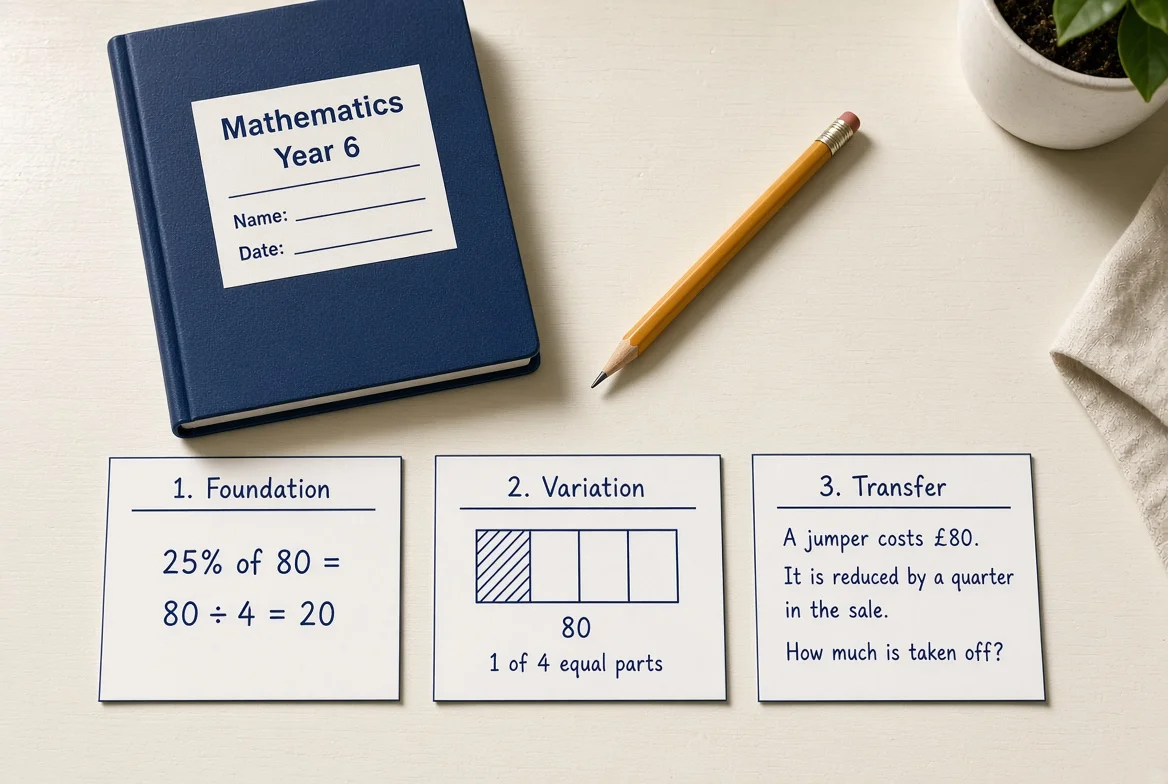
A Simple Parent Diagnostic: Three Versions of the Same Skill
Parents can learn a great deal by checking a skill in three stages:
- Foundation: Can your child answer a direct version of the question?
- Variation: Can they answer when the numbers or representation change?
- Transfer: Can they recognise the same skill inside a problem that does not tell them the method?

If the learner succeeds at the first stage but struggles at the third, the issue may be transfer rather than basic knowledge.
That is much more useful information than simply saying they “cannot do percentages” or “are weak at fractions”.
Should My Child Work Ahead Into Year 7 Maths?
Working ahead is not automatically the best preparation.
For many pupils, strengthening Year 6 foundations, mathematical language, reasoning and independence will create more value than prematurely covering secondary topics.
If foundations are already secure and the child is ready for greater challenge, extension can involve deeper problems, multiple methods and unfamiliar applications rather than simply accelerating through content.
How to Support Year 6 Maths at Home
- Use short, regular practice rather than occasional very long sessions.
- Ask your child to explain their method.
- Mix direct questions with reasoning and word problems.
- Revisit important number facts and earlier gaps.
- Encourage estimation and checking.
- Use everyday contexts such as money, time, recipes and measurement when appropriate.
- Keep examples of recurring errors and discuss them with the teacher.
- Avoid describing speed as the same thing as mathematical ability.
Parents do not need to recreate school at home. The aim is to strengthen useful habits and identify where support is needed.
When Might Additional Maths Support Help Before Secondary School?
One difficult topic does not automatically mean a child needs tuition.
Additional support may be worth considering if important foundation gaps persist, the same misconceptions repeatedly return, the child needs much more individual explanation than is currently available, confidence is falling or the transition to secondary school is causing concern because core skills remain insecure.
A tutor should not simply start teaching Year 7 early. The first task should be to establish the learner’s actual starting point.
See our latest article on How to Know If Your Child Needs a Maths Tutor
How Skinat Tuition Supports the Year 6 to Year 7 Transition
Skinat Tuition provides personalised online Maths tuition through qualified UK teachers.
For a Year 6 learner, we want to understand what is already secure, which gaps are likely to interfere with future learning and how independently the child can apply their knowledge.
The teaching priority may therefore be arithmetic fluency, fractions, problem solving, mathematical language, reasoning or another specific area rather than a generic “secondary school preparation” worksheet pack.
Our approach is:
DIAGNOSE → TEACH → PRACTISE
Diagnose the point of difficulty. Teach the missing knowledge or understanding. Practise it in increasingly varied situations so the learner becomes more independent.
See our services: Primary Tuition • Secondary Tuition • Programmes Hub • How to Know If Your Child Needs a Maths Tutor
A UK-Wide Note for Parents
This article uses Year 6 and the English national curriculum as its main reference point because that is the search intent being answered.
Families elsewhere in the UK should not assume that year-group terminology, curriculum sequencing or assessment arrangements are identical. Skinat Tuition supports learners across the UK, so tuition should be matched to the child’s actual nation, stage and curriculum.
Frequently Asked Questions
What maths should a Year 6 child know?
A Year 6 pupil following the English curriculum works across number and place value, the four operations, fractions/decimals/percentages, ratio, algebra, measurement, geometry and statistics, alongside reasoning and problem solving. Parents should check the current school curriculum and teacher feedback for the individual child.
Does my child need to know all Year 6 maths before starting Year 7?
Children do not enter Year 7 with identical profiles. The goal is not perfection in every topic. Secure high-leverage foundations and the ability to learn independently are particularly valuable, and secondary teachers will continue to develop mathematical knowledge.
Should we revise maths over the summer before Year 7?
Some light, targeted practice can help maintain fluency, especially where the school has identified specific gaps. Avoid turning the entire holiday into catch-up work. Focus on a small number of useful priorities.
What are the most important maths skills for secondary school?
Number fluency, fractions and proportional thinking, interpreting problems, mathematical vocabulary, reasoning, checking and independent problem solving all support later learning.
What if my child is below the expected level in Year 6 maths?
Speak to the school to understand which skills are causing concern. Prioritise the gaps that affect several topics, and consider additional targeted support if the difficulties are persistent.
Should my Year 6 child start GCSE maths early?
Usually there is more value in securing Key Stage 2 foundations and developing deeper reasoning than in racing ahead to GCSE content. Extension should be appropriate to the learner.
Can Skinat Tuition help with the move from Year 6 to Year 7?
Yes, where appropriate teacher availability exists. Support can focus on identified mathematical gaps and the skills needed for a more confident transition into secondary mathematics.
Conclusion: Secondary Readiness Is More Than a Topic Checklist
Year 6 maths matters because it provides foundations that secondary mathematics will continue to build upon.
But readiness is not demonstrated simply because a child has encountered every topic.
Can they use important number skills fluently? Do they understand the ideas underneath procedures? Can they reason, recognise the mathematics when the question changes and work with increasing independence?
Those questions reveal much more about readiness.
If there are gaps, identify them specifically and prioritise the ones that unlock future learning.
At Skinat Tuition, our qualified UK teachers use personalised teaching to diagnose gaps, strengthen understanding and help learners practise towards greater independence.
Your child’s first lesson is free, with no obligation to continue.
Discover more from Online Tutoring UK | Qualified Teachers | Skinat Tuition
Subscribe to get the latest posts sent to your email.