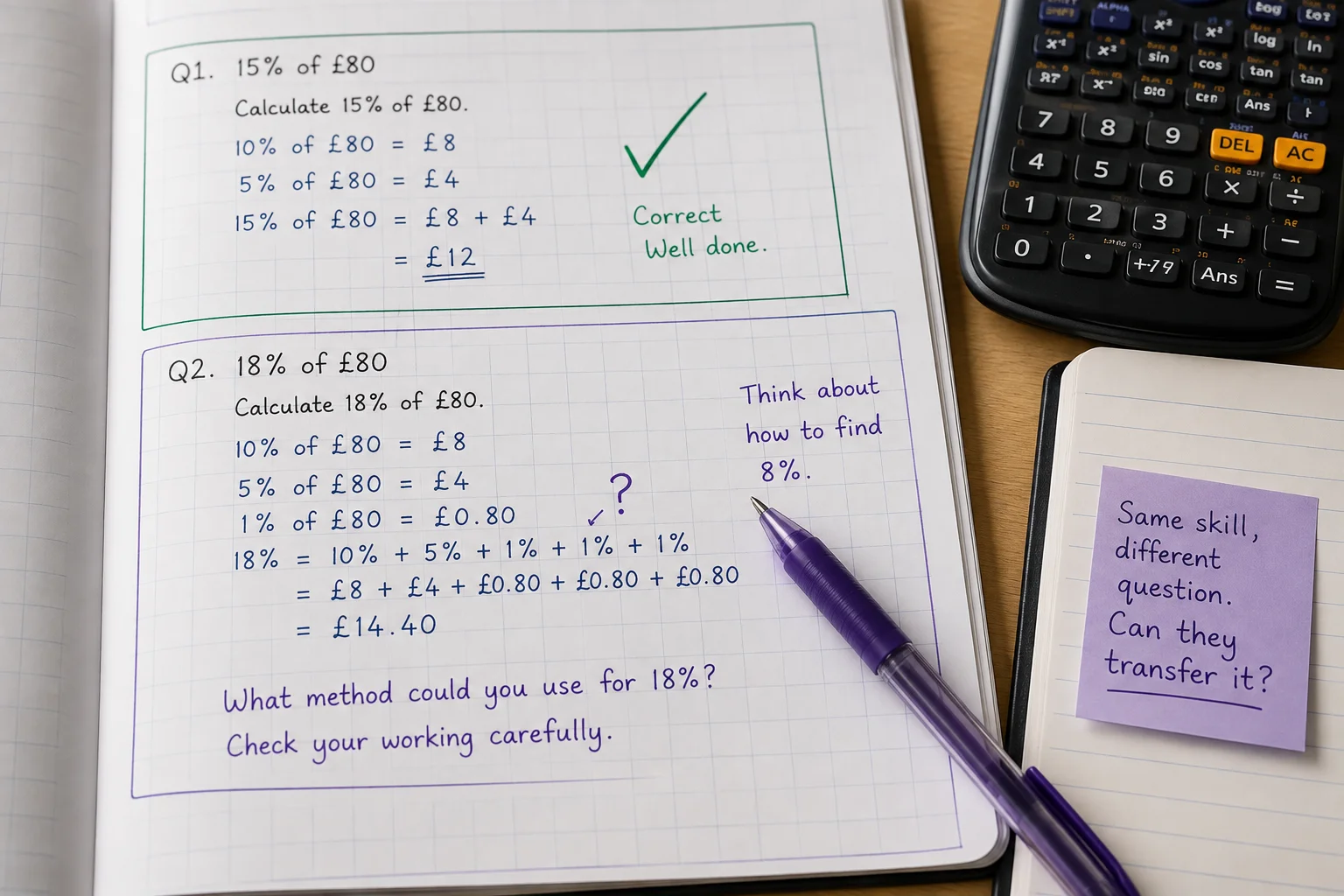
Stop treating every incorrect answer as the same type of error. Ask your child to identify where the first incorrect step occurred. Separate question-reading errors from mathematical-understanding errors. Teach a short checking routine rather than repeatedly saying “check your work”. Keep an error log of recurring patterns and use unfamiliar versions of familiar skills to test transfer.
The goal is not zero mistakes. It is to make errors visible enough that the learner can recognise, correct and increasingly prevent the patterns that repeatedly cost marks.
The Skinat Maths Error Audit
1. Know: Did the learner actually know the mathematical idea or prerequisite skill?
2. Read: Did they understand what the question was asking and notice important information, signs, units or constraints?
3. Choose: Did they select an appropriate method or strategy?
4. Execute: Did they carry out the method accurately?
5. Check: Did they test whether the answer was reasonable and answer the exact question?
6. Learn: After correction, can they explain the error and avoid it in a varied question?

KNOW → READ → CHOOSE → EXECUTE → CHECK → LEARN
Mistake Type 1: The Child Did Not Actually Know the Maths Securely
Sometimes a mistake looks careless because the child has answered similar questions correctly before. But one correct answer does not prove that the underlying skill is secure.
Change the numbers, representation or wording. If the method collapses, the issue may be understanding or transfer rather than carelessness. This is why simply telling the learner to slow down may not help. The mathematics itself may need reteaching.
Mistake Type 2: They Misread the Question
A capable learner can lose marks before doing any calculation.
Examples include missing a key instruction, using the wrong value from a table, answering in the wrong unit, calculating perimeter when area is required, or answering a related question rather than the one actually asked.
A useful habit is to pause before calculating and say: “What am I being asked to find?”
Mistake Type 3: They Choose the Wrong Method
Knowing several procedures does not automatically mean a child knows when each one should be used.
This becomes more visible when the question does not name the topic. A learner may be excellent at percentage worksheets but struggle when a real problem contains the same percentage relationship without an obvious clue.
That is a transfer problem, not necessarily a calculation problem. Good practice therefore includes questions where the learner must identify the mathematics independently.
Mistake Type 4: The Method Is Correct but the Execution Breaks Down
Here the learner understands the question and chooses the right strategy, but an arithmetic or algebraic slip changes the answer.
Examples include copying a number incorrectly, losing a negative sign, making a multiplication error or omitting a step.
The right intervention depends on the pattern. A repeated multiplication error needs a different response from repeatedly losing negative signs in algebra.
Mistake Type 5: They Do Not Check Whether the Answer Makes Sense
“Check your work” is often too vague. A child needs to know what checking actually means.
Useful checks can include estimating the likely size of an answer, using an inverse operation, checking units, rereading the final instruction, substituting an answer back where appropriate, or using a second method when efficient.
Checking should be taught as a mathematical skill, not used only as a reminder after something has gone wrong.
The Skinat 20-Second Final Check
- Did I answer what was asked?
- Does the size or sign of my answer make sense?
- Have I included the correct unit or form?
- Is there one high-risk calculation I should verify?
- Can I see a quick way to test the result?

The routine should become short enough to use consistently rather than a long checklist that is abandoned in an assessment.
Why 'Just Slow Down' Often Does Not Work
Some children do rush, and slowing down can help. But speed is not always the cause.
A learner can work slowly and still choose the wrong method. Another can work quickly and accurately because the underlying skills are fluent.
Before changing pace, identify the error type. The intervention should match the error.
Create an Error Log Instead of Repeating Whole Papers
An error log turns mistakes into data. After a test, homework or practice set, record a small number of meaningful errors.
- What was the question testing?
- What did I do?
- Where did the first error happen?
- What type of error was it?
- What should I do differently next time?
- Can I now answer a similar but different question?
Over time, patterns may become obvious. That gives teaching a much clearer target.
Do Not Correct the Whole Question for Them
When an adult immediately shows the correct solution, the child sees the answer but may not learn to locate their own error.
- Which line are you most confident about?
- Where does your answer first stop matching what you expected?
- What does this number represent?
- Could you check this step another way?
- Does the final answer fit the question?
The aim is to develop self-correction, not dependence on an adult to identify every mistake.
What If Mistakes Only Happen in Tests?
If classwork and homework are accurate but assessment performance falls, investigate what changes under test conditions.
- Time pressure
- Reading too quickly
- Skipping working
- Difficulty deciding which topic is being tested
- Anxiety or loss of confidence
- Poor time allocation
- Not returning to incomplete questions
Timed practice may help with assessment routines, but it should not replace teaching if the underlying mathematics is insecure.
What If My Child Gets Easy Questions Wrong but Hard Questions Right?
A learner may concentrate intensely on a challenging question but switch into automatic mode on something that looks familiar. They may also overcomplicate a simple question or assume they know what it asks without reading carefully.
Instead of labelling the easy error as careless, compare the working on both questions. The contrast can reveal the habit that needs teaching.
How Parents Can Help at Home
- Ask what type of mistake occurred rather than saying “you knew that”.
- Focus on one recurring error pattern at a time.
- Encourage clear working where it helps accuracy.
- Ask for an estimate before or after calculation.
- Use short mixed-question practice so the child must choose the method.
- Have the learner correct their own error before seeing a full solution.
- Praise explaining, checking, correcting and persisting.
- Do not make every mistake a sign that the child was not trying.
When Might Additional Maths Support Help?
Occasional slips are normal and do not automatically require tuition.
Additional support may be useful if the same error patterns persist, marks are consistently below what the learner’s understanding suggests, the child cannot identify why mistakes happen, or exam preparation is being undermined by repeated losses of avoidable marks.
A tutor should analyse the errors rather than simply give the learner more questions.
Learn more: My Child Is Struggling With Maths • How to Know If Your Child Needs a Maths Tutor
How Skinat Tuition Approaches Repeated Maths Errors
Skinat Tuition provides personalised online Maths tuition through qualified UK teachers.
When a learner repeatedly loses marks, we want to understand whether the issue is knowledge, question interpretation, method selection, execution, checking or transfer.
A child who misreads word problems needs different teaching from a child whose arithmetic is insecure. A child who knows a method but cannot recognise when to use it needs different practice from one who repeatedly loses accuracy in the final calculation.
Our approach is:
DIAGNOSE → TEACH → PRACTISE
Then we check whether the learner can apply the improvement independently in a different question.
Explore our services: Primary Tuition • Secondary Tuition • GCSE & National 5 Tuition • Programmes Hub
A UK-Wide Note for Parents
This article discusses mathematical learning habits that apply broadly, but curriculum terminology and qualifications differ across England, Wales, Scotland and Northern Ireland.
For examination preparation, the learner’s actual qualification and awarding body should guide teaching and practice materials.
Frequently Asked Questions
Why does my child keep making silly mistakes in Maths?
Repeated errors may come from question interpretation, insecure knowledge, choosing the wrong method, calculation accuracy, weak checking habits or difficulty transferring a skill. Classifying the error is more useful than simply calling it careless.
How can my child stop careless mistakes in Maths?
Identify recurring patterns and teach a specific routine for them. An error log, clear working, estimation, units checks and short final-answer checks can help when matched to the actual problem.
Should my child slow down in Maths tests?
Only if rushing is genuinely causing the errors. Slowing down will not fix insecure understanding or poor method selection. Analyse the mistakes first.
Why does my child get hard Maths questions right but easy ones wrong?
They may concentrate more carefully on challenging questions, rush familiar-looking ones or assume what an easy question is asking. Compare the working and checking habits across both types.
Are careless mistakes a sign my child does not understand Maths?
Not necessarily. Some errors occur despite secure understanding, while others reveal a misconception or transfer gap. Looking at the first incorrect step helps distinguish them.
Should we redo the whole Maths paper after a poor result?
Sometimes selected reattempts are more useful. Classify the errors, reteach what is necessary and then use new questions to check whether the learner has actually improved.
Can Skinat Tuition help reduce repeated Maths mistakes?
Yes, subject to appropriate teacher availability. The aim is to identify the error pattern and teach the relevant mathematical, reading, checking or assessment skill rather than promise mistake-free performance.
Conclusion: Stop Calling Every Error 'Silly'
Mistakes are useful when they tell us what to teach next.
If a capable child repeatedly loses marks, identify where the solution process breaks: knowledge, reading, method choice, execution, checking or transfer.
Once the error has a name, it can have a strategy. That is more powerful than repeatedly telling a child to concentrate, slow down or be careful.
At Skinat Tuition, our qualified UK teachers use personalised teaching to diagnose recurring gaps and errors, teach the relevant skill and help learners practise towards greater accuracy and independence.
Your child’s first lesson is free, with no obligation to continue.
Discover more from Online Tutoring UK | Qualified Teachers | Skinat Tuition
Subscribe to get the latest posts sent to your email.