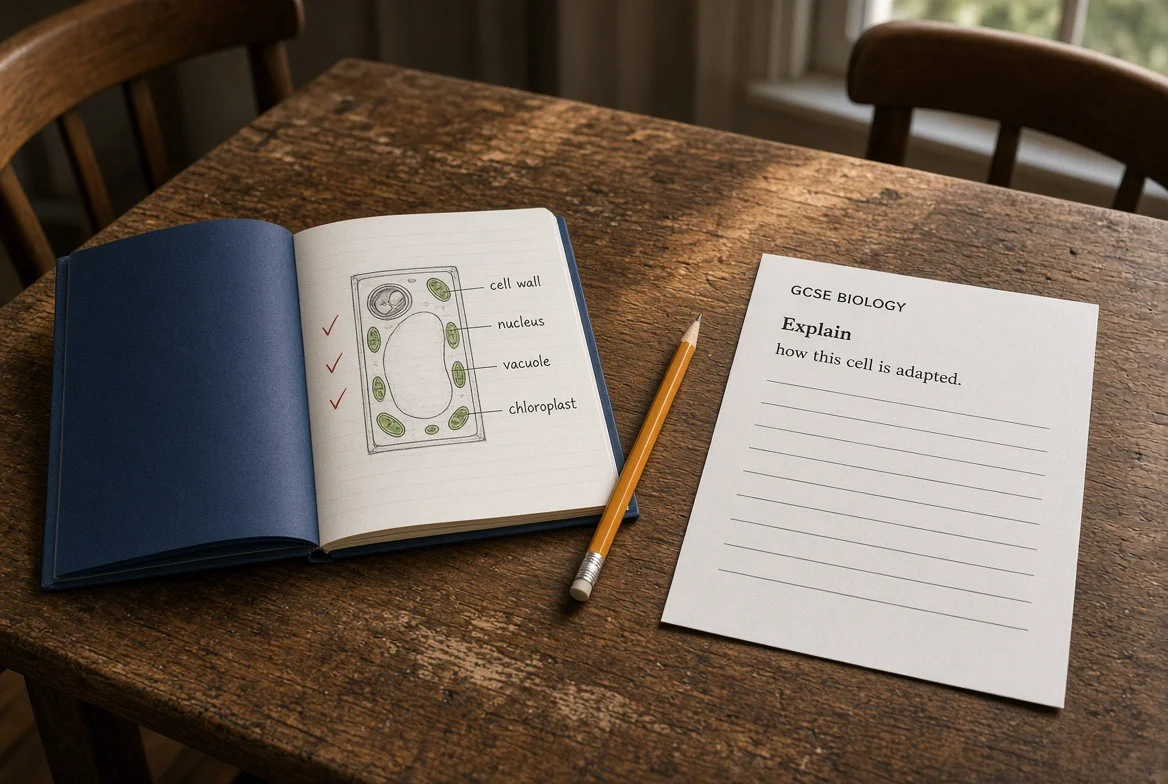
Effective GCSE Science revision is not simply spending more hours looking at notes.
Students need to remember a large body of knowledge, understand the underlying concepts, use mathematical skills, interpret practical and data-based questions, and apply familiar Science in unfamiliar contexts.
That means a strong revision plan should do more than cover content. It should repeatedly test whether knowledge can be recalled, explained and used independently.
The most useful revision question is not, “How long did I revise?” It is, “What can I now do without the notes that I could not do before?”
Quick Answer: What Is the Best Way to Revise GCSE Science?
- Start from the learner’s actual specification and recent assessment evidence.
- Prioritise weak and high-impact topics instead of revising everything equally.
- Use active retrieval rather than repeatedly rereading notes.
- Explain concepts in your own words to expose shallow understanding.
- Practise equations, units, graphs and other mathematical demands.
- Move quickly from recall to exam-style application questions.
- Mark work carefully and classify why marks were lost.
- Reteach the specific gap before attempting a new question.
- Use full past papers later to test integration, timing and independent performance.
The Skinat Science Revision Loop
1. Diagnose: Use assessments, teacher feedback and topic checks to identify the actual weak areas.
2. Retrieve: Recall key knowledge without looking at notes.
3. Explain: Show that the concept is understood, not merely memorised.
4. Apply: Use the Science in calculations, practical scenarios, data and unfamiliar questions.
5. Mark: Compare the response with reliable mark guidance and identify exactly where marks were lost.
6. Repair: Reteach or practise the specific knowledge, skill or misconception.
7. Retest: Use a different question later to check whether the improvement has transferred.
DIAGNOSE → RETRIEVE → EXPLAIN → APPLY → MARK → REPAIR → RETEST
1. Begin With the Correct GCSE Science Course
Before building a revision plan, establish exactly what the learner studies.
GCSE Combined Science and separate Sciences are not identical courses, and specifications differ between awarding bodies. IGCSE courses also have their own requirements.
Use the learner’s school information and current specification as the source of truth for content coverage, practical requirements, equations and assessment structure.
Do not build an entire revision plan from a generic online checklist without checking that it matches the actual course.
2. Diagnose Before Making a Revision Timetable
A timetable can look organised while allocating equal time to topics that are not equally weak.
Use recent mocks, end-of-topic tests, homework, teacher feedback and short diagnostic questions to identify priorities.
- Secure: can recall, explain and apply independently.
- Developing: understands some of the topic but makes recurring errors.
- Priority: important knowledge or skills are missing or misconceptions persist.
Revision time should respond to evidence. Priority areas normally need more deliberate teaching and practice than already-secure content.
3. Use Retrieval Instead of Only Rereading
Rereading can create familiarity, but familiarity is not the same as being able to recall information in an exam.
After reviewing a small section, close the notes and retrieve:
- Key definitions.
- Processes or sequences.
- Equations and what the symbols represent.
- Required relationships between variables.
- Practical principles.
- Important diagrams or models.
- Commonly confused scientific terms.
Then check what was missing. The act of trying to retrieve is part of the learning process.
4. Explain the Science Without the Textbook
A student may reproduce a definition while still having fragile conceptual understanding.
Ask them to explain the idea to another person, draw a simple diagram, predict what would happen if a variable changed, or compare it with a related concept.
If the explanation depends heavily on memorised wording, return to the concept before moving on.

5. Revise Biology, Chemistry and Physics Differently Where Necessary
All three Sciences require knowledge and application, but the balance of demands can differ by topic.
- Biology may require secure processes, terminology, interpretation and extended explanations.
- Chemistry may combine conceptual models, equations, quantitative work and practical reasoning.
- Physics often places substantial demands on mathematical relationships, units, graphs and applying models.
Do not force every topic into the same revision activity. Choose the method that matches the knowledge and skill being learned.
6. Do Not Ignore Maths in Science
A Science revision plan should include the mathematical skills required by the learner’s course.
Depending on the specification, this can include rearranging equations, ratios, percentages, standard form, graphs, gradients, unit conversion and proportional reasoning.
When a calculation is wrong, identify whether the learner selected the wrong Science relationship or made a mathematical execution error. The correction depends on that distinction.
7. Revise Required Practical and Experimental Reasoning
Students should not treat practical Science as a script to memorise without understanding.
They need to reason about variables, methods, measurements, results, limitations and improvements at the level required by their course.
- What is being changed?
- What is being measured?
- What needs to be controlled?
- Why is this measurement taken?
- What could reduce confidence in the result?
- How could the method be improved?
Use the actual specification to confirm which practical knowledge is required.
8. Move From Direct Questions to Application
A revision session should not end when the student can answer a familiar question.
Use a progression:
- Direct recall.
- Standard application.
- Changed context.
- Data or practical context.
- Unsignposted exam-style question.
This helps reveal whether the learner recognises the underlying Science when surface details change.
9. Use Past Papers as a Diagnostic Tool
Past papers are most powerful when they produce information about what to teach next.
After marking, classify errors:
- Knowledge gap.
- Misconception.
- Application/transfer.
- Calculation or unit error.
- Graph/data interpretation.
- Practical reasoning.
- Command-word misunderstanding.
- Vague scientific language.
- Incomplete explanation.
- Timing or question-management issue.
Then repair the important errors before completing another full paper.
The Skinat 30-Minute Science Revision Block
A focused revision block can be structured like this:
- 5 minutes — closed-book retrieval of one small topic.
- 8 minutes — check, correct and explain weak points.
- 10 minutes — exam-style questions including at least one changed context.
- 5 minutes — mark and classify errors.
- 2 minutes — write the next action and schedule a retest.
This is an example structure, not a universal rule. Longer or shorter sessions may suit different learners, topics and circumstances.
10. Space Revision and Revisit Topics
A topic that feels secure immediately after study may not remain secure weeks later.
Build planned revisits into the revision schedule rather than finishing a topic once and never returning to it.
The retest should require retrieval before notes are opened. If knowledge has faded, repair it and schedule another check.
11. Mix Topics Once the Foundations Are Secure
Real exam papers do not usually announce which revision session a question belongs to.
Mixed practice forces the learner to decide what knowledge and method are relevant.
This is especially useful later in revision, after individual weak topics have first been taught securely.
12. Make the Revision Plan Responsive
Do not keep following a timetable simply because it was written weeks ago.
If a topic improves, reduce its priority. If a new mock exposes a major weakness, change the plan.
A revision plan should be a live response to evidence, not a fixed calendar that ignores progress.
What Should Parents Look For?
- Is revision active, or mostly reading and highlighting?
- Can your child explain what they revised without the notes?
- Are weak topics receiving more attention than favourite topics?
- Are calculations and data questions included?
- Are mistakes being analysed and corrected?
- Are past papers followed by reteaching?
- Is the learner using the correct course/specification materials?
- Can they apply the same Science when the question looks different?
Common GCSE Science Revision Mistakes
- Revising only favourite topics.
- Spending most of the session making attractive notes.
- Memorising mark schemes without understanding.
- Completing past papers without repairing errors.
- Ignoring Maths within Science.
- Learning practical methods without understanding why steps are used.
- Using resources for the wrong specification.
- Leaving application questions until immediately before the exam.
- Measuring revision by hours rather than improvement.
When Might a GCSE Science Tutor Help?
A tutor may be useful when diagnostic evidence shows persistent gaps that the learner is not resolving independently or through current school support.
The tutor should use the learner’s actual course and assessment evidence to prioritise teaching.
Useful support may focus on Biology, Chemistry, Physics, calculations, application, practical reasoning or exam responses rather than simply repeating the entire curriculum.
Learn More: My Child Is Struggling With Science • How to Know If Your Child Needs a Science Tutor • Why Does My Child Know Science but Still Lose Marks in Exams?
How Skinat Tuition Supports GCSE Science Revision
Skinat Tuition provides personalised online Science tuition through qualified UK teachers.
We use the learner’s stage, course, assessment evidence and identified gaps to decide what should be taught and practised.
Our core approach is:
DIAGNOSE → TEACH → PRACTISE
For exam preparation, that becomes a continuous revision loop: diagnose the gap, retrieve the knowledge, explain it, apply it, mark the response, repair the error and retest later.
Learn More: Primary Tuition • GCSE/IGCSE Tuition • Secondary Tuition • Programmes Hub
A UK-Wide Qualification Note
This article targets GCSE Science search intent, but Skinat Tuition supports families across the UK.
GCSE, IGCSE, National 5 and other qualifications have different specifications and assessment structures. Learners should revise from materials aligned to their actual course rather than assuming all UK Science qualifications are interchangeable.
Frequently Asked Questions
How many hours a day should I revise GCSE Science?
There is no universal number that guarantees success. The quality, focus and consistency of revision matter. Build a realistic schedule around the learner’s current gaps, other subjects, school commitments and wellbeing.
What is the best revision method for GCSE Science?
Use a combination of active retrieval, explanation, targeted questions, application, calculation practice, error analysis and spaced retesting. The exact balance should respond to the learner’s evidence.
Should I revise Biology, Chemistry and Physics every week?
That can be useful, but frequency should reflect the course, proximity of assessments and the learner’s strengths and weaknesses. Avoid giving equal time automatically when the needs are unequal.
When should I start GCSE Science past papers?
Exam-style questions can be used throughout learning. Full papers become more useful when enough content has been covered for the paper to provide meaningful diagnostic and timing information.
Are flashcards good for GCSE Science?
They can be useful for retrieval of concise knowledge, but they should not replace explanation, calculations, data interpretation and application questions.
How do I revise GCSE Science equations?
Learn what the quantities and units mean, practise selecting the correct relationship, substitute values accurately and apply the equation in varied contexts. Follow the requirements of the learner’s actual specification.
Can Skinat Tuition help with GCSE Science revision?
Yes, subject to appropriate teacher availability. Support can be matched to the learner’s course, assessment evidence and priority Science gaps.
Conclusion: Revision Should Change What the Learner Can Do
Good GCSE Science revision is not measured by the number of highlighted pages or hours spent at a desk.
It should improve what the learner can retrieve, explain, calculate and apply without support.
Use assessment evidence to choose priorities, active retrieval to strengthen memory, application questions to test transfer and error analysis to decide what to repair next.
At Skinat Tuition, our qualified UK teachers use personalised teaching and assessment evidence to help learners focus revision on the Science that actually needs improvement.
Your child’s first lesson is free, with no obligation to continue.
Discover more from Online Tutoring UK | Qualified Teachers | Skinat Tuition
Subscribe to get the latest posts sent to your email.