How to Revise GCSE Biology Effectively
GCSE Biology can feel like a subject with an enormous number of facts to remember.
But strong Biology performance depends on more than memorising definitions and processes.
Students also need to understand how biological ideas connect, interpret diagrams and data, reason about practical investigations and apply familiar knowledge when an exam question uses an unfamiliar context.
Effective Biology revision should therefore move from remembering knowledge to using it.
Quick Answer: What Is the Best Way to Revise GCSE Biology?
- Use the learner’s actual specification to identify required content.
- Prioritise weak topics using recent assessment evidence.
- Retrieve key facts and processes without notes.
- Draw and label biological structures or processes from memory where useful.
- Explain why a process happens rather than only memorising its steps.
- Connect related topics so knowledge is not stored in isolated blocks.
- Practise interpreting graphs, tables, diagrams and experimental data.
- Move from direct questions to unfamiliar application questions.
- Mark answers carefully, repair the cause of lost marks and retest later.
The Skinat Biology Revision Cycle
1. Recall: Can the learner retrieve the key knowledge without looking at notes?
2. Visualise: Can they represent useful structures, pathways or processes accurately through a diagram, sequence or model?
3. Explain: Can they explain why the process happens and use precise biological vocabulary?
4. Connect: Can they link the topic to related biological ideas?
5. Apply: Can they use the knowledge in an unfamiliar organism, experiment, graph or scenario?
6. Mark: Can they identify exactly why an answer gained or lost marks?
7. Retest: Can they answer a different question later without the original support?
RECALL → VISUALISE → EXPLAIN → CONNECT → APPLY → MARK → RETEST
1. Start With the Correct Biology Specification
Biology content and assessment requirements vary between GCSE and IGCSE specifications and between awarding bodies.
Students should use the specification and information provided by their school to establish what they actually need to learn.
A generic online checklist can be useful for organisation, but it should not replace the learner’s real course specification.
2. Do Not Revise Every Biology Topic Equally
Use mocks, topic tests, homework and teacher feedback to classify topics.
- Secure — knowledge can be recalled, explained and applied.
- Developing — some knowledge is present but errors recur.
- Priority — important content is missing, confused or difficult to apply.
Revision should spend more time repairing priority areas than repeatedly revisiting comfortable topics.
3. Use Active Recall for Biological Knowledge
Biology contains terminology, structures, processes and relationships that need to be retrievable.
After reviewing a small section, close the notes and recall what you know.
- Write the key terms from memory.
- Reconstruct a process in the correct order.
- Draw and label a relevant diagram.
- State the function of a structure.
- Explain the relationship between two variables or biological ideas.
- List common misconceptions you need to avoid.
Then compare with reliable course material and correct what was missing.
4. Use Diagrams as Thinking Tools, Not Decoration
Diagrams can be powerful in Biology when they help the learner reconstruct meaning.
Instead of copying a perfect diagram repeatedly, try drawing the important features from memory and explaining what each part does.
For a process, arrows can show sequence or movement. For a system, a diagram can help the learner connect structure and function.
The goal is understanding, not artistic quality.
5. Explain the 'Why', Not Only the 'What'
A learner may know that a biological process occurs but still struggle when asked to explain it.
For each important process, ask:
- What happens?
- Where does it happen?
- What causes it?
- Why is it useful or significant?
- What would change if one condition changed?
- How does it connect to another part of the topic?
These questions expose whether the knowledge is conceptual or simply memorised.
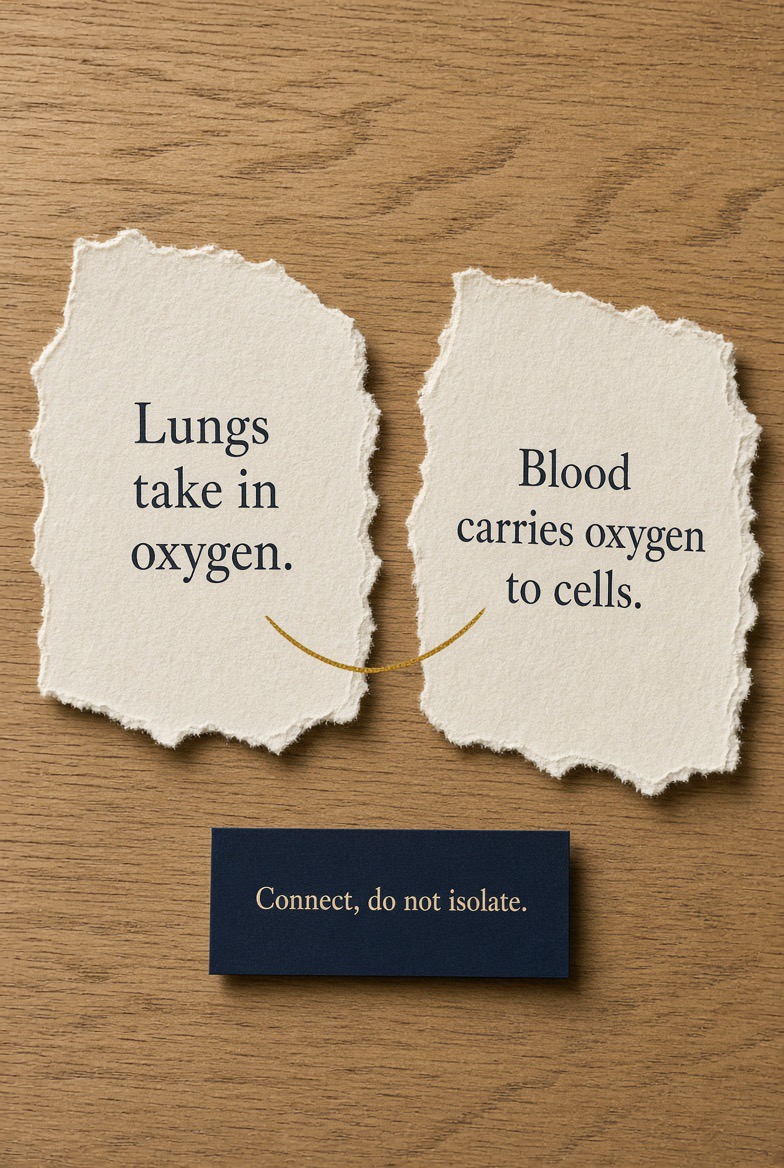
6. Build Connections Between Biology Topics
Biology becomes easier to apply when knowledge is connected.
For example, cells connect to tissues and organs; transport systems connect to exchange surfaces; enzymes connect to digestion and metabolism; genetics connects to variation and evolution.

Create short concept maps only when they clarify relationships. Avoid producing large decorative maps that are never tested from memory.
7. Practise Scientific Vocabulary Precisely
Biology answers can lose clarity when everyday language replaces scientific terminology.
Create small sets of easily confused terms and explain the difference between them.
Then use each term inside a complete biological explanation. Knowing a definition is useful; knowing when and why to use the term is stronger.
8. Revise Biology Practical Reasoning
Students may be asked to reason about experimental design, variables, measurements, results and improvements according to their course requirements.
- What is the independent variable?
- What is measured?
- What should be controlled?
- Why is a particular method or measurement used?
- What pattern does the data show?
- Is there an anomalous result?
- What change could improve the investigation?
Do not memorise practical steps without understanding their purpose.
9. Practise Graphs, Tables and Data
Biology assessments often require students to extract information and then interpret it scientifically.
Practise reading axes and scales carefully, calculating where required, describing patterns, comparing data and linking the pattern to relevant Biology.
Separate “what the data shows” from “why Biology explains the pattern”.
10. Move From Recall to Unfamiliar Application
A student who only practises direct questions can feel confident until the exam changes the context.
Use this progression:
- Direct knowledge question.
- Explain the concept.
- Apply it to a familiar biological context.
- Apply it to a changed organism, experiment or scenario.
- Answer an unsignposted exam-style question.
This tests whether the learner can recognise the underlying Biology independently.
The Skinat Biology Transfer Check
- Can I state the knowledge?
- Can I explain it without my notes?
- Can I draw or represent it where useful?
- Can I connect it to another Biology idea?
- Can I use it when the context changes?
- Can I explain why my exam answer earns the marks?
A “no” identifies the next revision action more clearly than simply saying a topic is weak.
11. Use Past Papers After Teaching, Not Instead of Teaching
Past papers are valuable, but they do not automatically repair weak Biology.
After marking a question, classify the error:
- Knowledge missing.
- Misconception.
- Vocabulary too vague.
- Application failure.
- Graph/data error.
- Practical reasoning error.
- Calculation error.
- Command-word misunderstanding.
- Incomplete explanation.
Repair the specific weakness, then use a different question to test whether the improvement transfers.
A 30-Minute GCSE Biology Revision Block
- 5 minutes — closed-book retrieval.
- 7 minutes — check and repair missing knowledge.
- 5 minutes — explain or draw the key concept from memory.
- 8 minutes — exam-style application questions.
- 3 minutes — mark and classify errors.
- 2 minutes — record what to retest later.
This is a flexible example rather than a required timetable. The appropriate length depends on the learner and topic.
Common GCSE Biology Revision Mistakes
- Only rereading the textbook.
- Making notes for hours without testing recall.
- Memorising definitions but not practising explanations.
- Ignoring graphs, data and practical reasoning.
- Revising favourite topics more than weak ones.
- Completing past papers without analysing errors.
- Using mark-scheme phrases without understanding.
- Using resources that do not match the learner’s specification.
- Assuming a correct direct question means the topic is secure.
How Parents Can Support GCSE Biology Revision
- Ask your child to teach you one process without notes.
- Ask them to draw a diagram or sequence from memory.
- Ask, “Why does that happen?” after a factual answer.
- Encourage them to use assessment evidence to choose priorities.
- Check that revision includes exam questions as well as notes.
- Ask what type of mistake was made after marking.
- Encourage planned retesting rather than one-off revision.
When Might Additional Biology or Science Support Help?
Additional tuition may be useful if persistent Biology gaps remain despite school support and independent revision, or if the learner understands content but repeatedly struggles to apply it in assessment questions.
The teaching should be targeted to the actual need rather than simply repeating the course from the beginning.
Learn More on: How to Revise GCSE Science Effectively • My Child Is Struggling With Science • How to Know If Your Child Needs a Science Tutor • Why Does My Child Know Science but Still Lose Marks in Exams?
How Skinat Tuition Supports GCSE Biology
Skinat Tuition provides personalised online Science tuition through qualified UK teachers.
For Biology, we use the learner’s course, assessment evidence and identified gaps to decide whether the priority is knowledge, conceptual understanding, vocabulary, practical reasoning, data, application or exam response.
Our core approach is:
DIAGNOSE → TEACH → PRACTISE
Then we use changed questions to check whether the learner can apply the Biology independently.
Explore More: Primary Tuition • GCSE/IGCSE Tuition • Secondary Tuition • Programmes Hub
A UK-Wide Qualification Note
This article targets GCSE Biology search intent. GCSE, IGCSE, National 5 and other UK Science qualifications have different content and assessment requirements.
Learners should use revision materials aligned to their actual qualification and specification. Skinat Tuition’s UK-wide support should likewise be matched to the learner’s educational context.
Frequently Asked Questions
What is the best way to revise GCSE Biology?
Combine active recall, explanation, diagrams where useful, application questions, practical and data skills, error analysis and spaced retesting. Use the learner’s actual specification.
Are flashcards good for GCSE Biology?
They can help with concise knowledge and vocabulary, but they should be combined with explanation and application. Flashcards alone do not test whether a learner can use Biology in unfamiliar questions.
How do I remember Biology processes?
Break the process into meaningful stages, retrieve it from memory, explain why each stage happens and revisit it over time. Diagrams or sequences can help when they clarify the mechanism.
How should I revise Biology practicals?
Understand the purpose of the method, variables, measurements, results and possible improvements rather than memorising a script without meaning. Follow the requirements of the learner’s actual specification.
How can I improve GCSE Biology application questions?
After learning the concept, practise it across changed contexts. Before answering, identify which biological idea the question is testing and connect that idea explicitly to the scenario.
Should I do GCSE Biology past papers every week?
There is no universal frequency. Past papers are most useful when enough content has been covered and when errors are analysed, repaired and retested.
Can Skinat Tuition help with GCSE Biology?
Yes, subject to appropriate teacher availability. Support can target the learner’s course and identified Biology or wider Science gaps.
Conclusion: Biology Revision Should Move Beyond Memorising Facts
Knowledge matters in GCSE Biology, but the exam also asks students to explain, connect, interpret and apply it.
Effective revision therefore moves from recall to understanding and then into unfamiliar questions.
Use assessment evidence to choose priorities, test knowledge without notes, repair misconceptions and return later to check retention.
At Skinat Tuition, our qualified UK teachers use personalised teaching to help learners strengthen Biology knowledge and apply it with increasing independence.
Your child’s first lesson is free, with no obligation to continue.
Discover more from Online Tutoring UK | Qualified Teachers | Skinat Tuition
Subscribe to get the latest posts sent to your email.