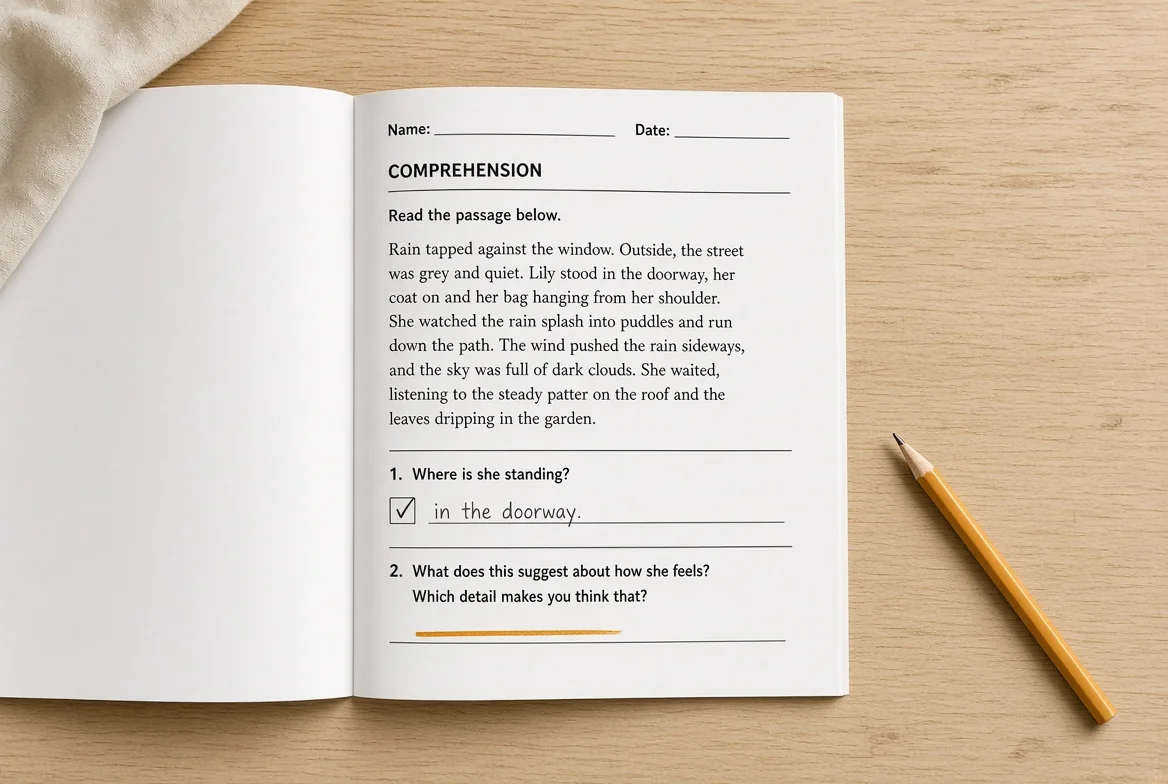
A child can read every word on a page and still struggle to understand what they have read.
That is because reading fluency and reading comprehension are connected, but they are not the same skill.
Comprehension requires the learner to build meaning: understand vocabulary, retrieve information, connect ideas, infer what is not stated directly, select evidence and explain their thinking.
If your child finds comprehension difficult, giving them more passages and more questions may not be enough. The first task is to identify which part of the comprehension process is breaking down.
Once that becomes clear, practice can become much more purposeful.
Quick Answer: How Can I Help My Child Improve Reading Comprehension?
- Choose texts that your child can read with enough fluency to focus on meaning.
- Discuss unfamiliar vocabulary before and during reading.
- Pause after short sections and ask your child to explain what has happened in their own words.
- Ask questions that require both retrieval and inference.
- Always ask, “What in the text makes you think that?”
- Teach your child to find relevant evidence rather than copying a whole paragraph.
- Practise summarising the most important idea.
- Ask your child to explain how they reached an answer.
- Use different texts so the skill is transferred rather than memorised.
- Keep practice short enough for the child to think carefully rather than rush.
The aim is not to ask more questions. It is to improve the thinking that happens between reading the question and giving the answer.
The Skinat Comprehension Cycle
1. Understand the question: What is the question actually asking the reader to find, infer or explain?
2. Find evidence: Which word, sentence or section of the text is relevant?
3. Think: What does that evidence mean in this context?
4. Explain: How does the evidence support the answer?
5. Check: Does the response answer the question and make sense with the text?
6. Transfer: Can the child use the same reading skill on a different text without being told exactly what to do?
QUESTION → EVIDENCE → THINK → EXPLAIN → CHECK → TRANSFER
1. Make Sure the Text Is Not Using All of Your Child's Attention
Comprehension becomes difficult when the child is using most of their attention simply to work out the words.
If reading is highly effortful, choose a text where word reading is manageable enough for your child to think about meaning. More challenging books can still be enjoyed when an adult reads aloud and discusses them.
This distinction allows children to develop comprehension and vocabulary even when their independent reading fluency is still developing.
2. Build Vocabulary in Context
A child cannot fully understand a sentence if several important words are unfamiliar.
Before giving the meaning immediately, help your child investigate the word:
- Read the whole sentence again.
- Look for clues in the surrounding sentences.
- Think about whether part of the word is familiar.
- Suggest a possible meaning.
- Replace the word with the suggested meaning and check whether the sentence still makes sense.
Afterwards, use the word in another sentence. Repeated meaningful encounters are more useful than memorising a definition once.
3. Separate Retrieval From Inference
Parents often hear the word “inference” but may not know what it means in practice.
Retrieval asks the reader to find information that is stated directly. Inference asks the reader to combine clues with what they understand to reach a sensible conclusion.
For example, if a text says that a character pulled their coat tightly around them and their teeth were chattering, the reader may infer that the character is cold even if the word “cold” never appears.
Both skills matter, but they require different thinking. If a child can retrieve facts but struggles with inference, the solution is not simply more retrieval questions.
4. Ask for Evidence Every Time an Interpretation Is Made
One of the most useful habits for comprehension is connecting an idea to the text.
After your child gives an answer, ask:
“What in the text makes you think that?”
This encourages the learner to return to the evidence rather than guess.
Over time, the child should become more precise: instead of pointing to an entire paragraph, they learn to select the particular word, phrase or detail that supports the answer.
5. Teach the Difference Between Evidence and Explanation
Finding the correct quotation is not the end of the thinking.
A learner may copy the perfect sentence from the text but still not explain what it shows.
Try this sequence:
- Answer: What do you think?
- Evidence: Which detail supports that idea?
- Explain: What does that detail show?
- Connect: How does that answer the question?
This simple structure prepares children for increasingly analytical reading as they move through school.
6. Practise Summarising Without Retelling Everything
Some children respond to “What was this about?” by retelling almost every event.
Summarising requires them to decide which information matters most.
After a paragraph or short section, try asking:
- What is the most important thing we learned?
- If you could keep only one sentence from this section, what idea would it need to contain?
- What changed in this part?
- Which details could we remove without losing the main meaning?
This teaches children to distinguish central ideas from supporting detail.
7. Encourage Prediction—but Make It Evidence-Based
Prediction can develop active reading when it is connected to evidence.
Instead of only asking “What do you think will happen next?”, add:
“Which clue in the text makes you predict that?”
A prediction does not need to turn out to be correct. What matters is whether the child used the text to form a reasonable idea.
8. Ask Your Child to Explain the Text in Their Own Words
Copying a sentence does not necessarily show understanding.
After reading a short section, ask the child to explain it as if they were telling someone who had not read it.
If they cannot do this without repeating the text almost word for word, they may need help processing the meaning.
This technique can also reveal vocabulary that looked familiar during reading but was not actually understood.
9. Do Not Turn Every Reading Session Into a Test
Comprehension develops through discussion as well as formal questions.
Talk about characters, surprising facts, interesting vocabulary, opinions and connections to other things the child knows.
If every page is followed by a sequence of assessment questions, reading can begin to feel like constant examination.
The goal is to create thoughtful readers, not children who expect a worksheet after every book.
10. Use the Same Skill Across Different Texts
A child may learn to answer one familiar worksheet format without developing a transferable comprehension skill.
Once a strategy has been taught, change the text.
- Practise inference in a story.
- Then use inference in a short non-fiction passage.
- Then ask an inference question where the wording is unfamiliar.
- Finally, see whether the child recognises independently that inference is needed.

Transfer is one of the strongest signs that a skill is becoming secure.
The Skinat 3-Level Comprehension Check
When practising one reading skill, test it at three levels:
- Level 1 — Supported: the adult models the thinking and the child completes part of the process.
- Level 2 — Guided: the child works independently but receives a small prompt if needed.
- Level 3 — Independent Transfer: the child applies the skill to a different text without being told the method.

If the child succeeds only at Level 1, they are learning the skill but do not yet own it independently.
That is useful information for deciding what to teach next.
Why Does My Child Get Comprehension Questions Wrong?
An incorrect answer can come from several different places.
- The question was misunderstood.
- The relevant section of the text was not located.
- Important vocabulary was not understood.
- The child retrieved a fact when inference was required.
- The evidence was correct but the explanation was weak.
- The child answered from general knowledge rather than the text.
- The child rushed and did not check the answer.
- The reading itself was too effortful for the child to retain meaning.
Before correcting the answer, identify which of these happened. Otherwise, the child may be told the correct response without learning how to produce it next time.
How Parents Can Use School Reading Feedback
If school feedback says your child needs to improve comprehension, ask for greater specificity.
- Is retrieval secure?
- Is inference the main difficulty?
- Does vocabulary limit understanding?
- Can my child summarise?
- Can they select evidence?
- Can they explain an answer?
- Is fluency affecting comprehension?
- Does the difficulty appear across fiction and non-fiction?
The more specific the feedback becomes, the easier it is to choose useful practice.
What If My Child Hates Reading Comprehension?
Repeated difficulty can make children avoid the activity that would help them improve.
Reduce unnecessary workload while keeping the thinking demanding. One carefully discussed paragraph can sometimes teach more than three rushed pages of questions.
Use subjects the child finds interesting, vary fiction and non-fiction, and make success visible.
Confidence should grow from improved understanding—not from pretending difficult work is easy.
When Might Additional Reading Support Help?
Not every comprehension difficulty requires private tuition.
Additional teaching may be useful when the same difficulty persists despite school support and appropriate home practice, the learner needs more individual modelling and feedback, reading difficulties are affecting several subjects, or confidence is deteriorating.
A tutor should diagnose which reading skill needs attention rather than simply provide more comprehension worksheets.
See our latest guide:
My Child Is Behind in Reading: What Can I Do?
How to Know If Your Child Needs an English Tutor
How Skinat Tuition Teaches Reading Comprehension
Skinat Tuition provides personalised online English tuition through qualified UK teachers.
We first identify whether the learner’s difficulty lies in vocabulary, retrieval, inference, evidence, explanation, summarising, fluency or independent application.
Teaching can then target that specific skill before asking the learner to apply it in increasingly varied texts.
Our approach is:
DIAGNOSE → TEACH → PRACTISE
The goal is not simply a higher score on one comprehension worksheet. It is for the learner to understand what good readers do and apply those habits with increasing independence.
Learn more: Primary Tuition • Online English Tutor UK • My Child Is Behind in Reading • Year 6 English Before Secondary School • Programmes Hub
A UK-Wide Note for Parents
This article provides general reading-comprehension guidance for UK families rather than a fixed nation-specific attainment checklist.
Curriculum terminology and expectations differ across England, Wales, Scotland and Northern Ireland. Parents should use school feedback and the curriculum relevant to their child’s educational setting.
Skinat Tuition provides UK-wide online support and should match teaching to the learner’s actual stage and curriculum.
Frequently Asked Questions
What is reading comprehension?
Reading comprehension is the process of understanding and constructing meaning from a text. It can involve retrieving information, understanding vocabulary, making inferences, summarising, connecting ideas and explaining interpretations with evidence.
Why can my child read well but not understand what they read?
Word-reading fluency and comprehension are different. Vocabulary, language understanding, inference, attention to meaning or the ability to connect ideas may need further development.
How can I improve my child’s inference skills?
Use short texts and ask what the text suggests rather than only what it states directly. Always ask the child to identify the clue that supports the inference.
Are reading comprehension worksheets useful?
They can be useful when they target an identified skill and the answers are discussed. Repeated worksheets are less useful if the child keeps making the same mistake without understanding why.
How long should we practise reading comprehension?
There is no universal ideal duration. Short, focused practice that allows careful thinking can be more productive than a long session in which the child becomes tired or rushes.
Should I give my child harder books to improve comprehension?
Not automatically. If decoding or vocabulary demands are too high, the child may have little attention left for meaning. Challenge can also come from deeper discussion of an accessible text.
Can Skinat Tuition help with primary reading comprehension?
Yes, subject to appropriate teacher availability. Tuition can identify the learner’s specific comprehension difficulty and provide targeted teaching and practice.
Conclusion: Better Comprehension Comes From Better Thinking, Not Just More Questions
Reading comprehension improves when children understand what to do with a text—not simply when they complete more worksheets.
Teach them to understand the question, find relevant evidence, think about what it means, explain the connection and check that the answer makes sense.
Then change the text and see whether they can use the same skill again.
That final step matters because secure comprehension is transferable.
At Skinat Tuition, our qualified UK teachers use personalised teaching to diagnose the reading skill that needs development, teach it explicitly and help learners practise towards greater independence.
Your child’s first lesson is free, with no obligation to continue.
Discover more from Online Tutoring UK | Qualified Teachers | Skinat Tuition
Subscribe to get the latest posts sent to your email.