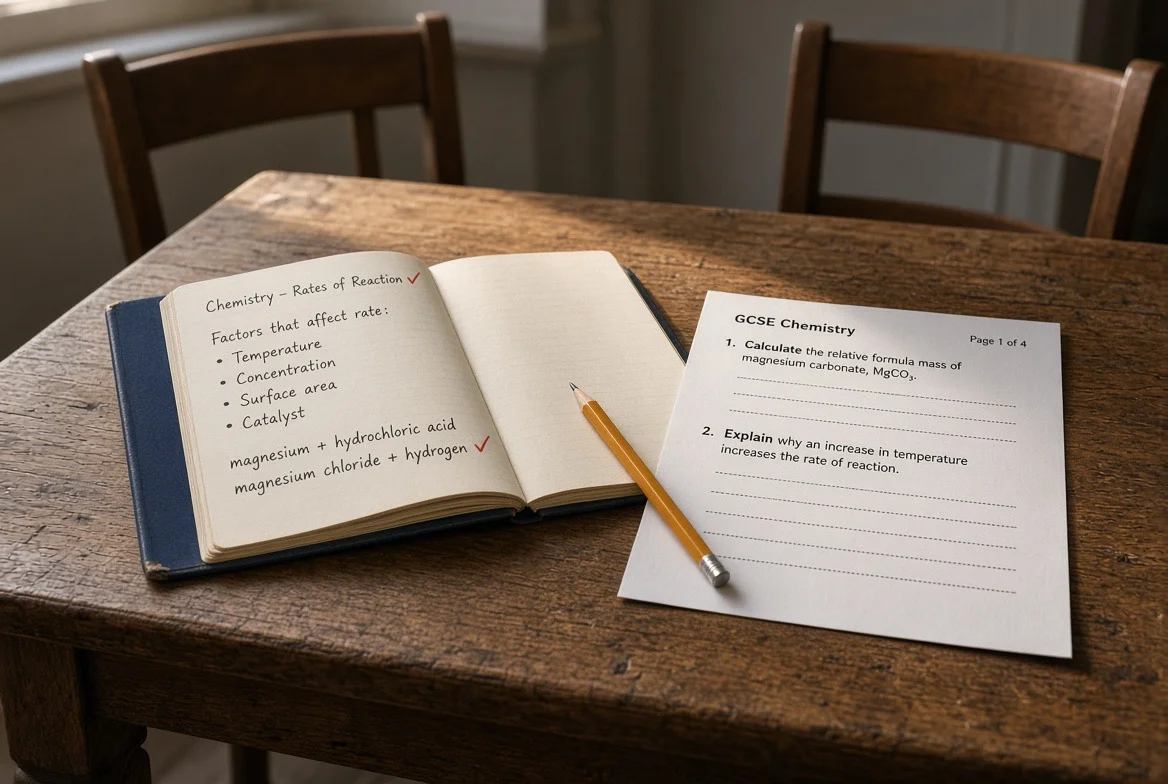
GCSE Chemistry combines factual knowledge, abstract models, chemical language, equations, calculations, practical reasoning and unfamiliar application.
That is why simply rereading a revision guide can leave a student feeling prepared while important weaknesses remain hidden.
Effective Chemistry revision should test whether the learner can move between what is happening at particle level, how it is represented symbolically and what the question requires them to calculate or explain.
The aim is not only to remember Chemistry. It is to use Chemistry independently.
Quick Answer: What Is the Best Way to Revise GCSE Chemistry?
- Use the learner’s actual specification and school course information.
- Prioritise weak topics using assessments rather than revising everything equally.
- Retrieve definitions, trends, reactions and key relationships without notes.
- Use particle or structural models to explain what is happening where appropriate.
- Practise formulae, symbols and chemical equations accurately.
- Separate Chemistry understanding from mathematical execution in calculations.
- Revise practical reasoning, variables, observations and data.
- Move from direct questions to unfamiliar applications.
- Mark, classify errors, repair the gap and retest with a different question.
The Skinat Chemistry Revision Cycle
1. Recall: Can the learner retrieve the relevant facts, definitions, patterns and relationships?
2. Model: Can they explain what is happening using an appropriate particle, atomic, bonding or reaction model?
3. Represent: Can they use chemical symbols, formulae, equations, diagrams or graphs accurately where required?
4. Calculate: Can they select the correct relationship and complete the mathematical steps with suitable units and precision?
5. Apply: Can they use the Chemistry in an unfamiliar substance, reaction, experiment or context?
6. Mark: Can they identify exactly why an answer gained or lost marks?
7. Retest: Can they solve a different question later without the original support?

RECALL → MODEL → REPRESENT → CALCULATE → APPLY → MARK → RETEST
1. Start With the Correct Chemistry Specification
GCSE and IGCSE Chemistry content, equations, practical requirements and assessment structures vary between specifications and awarding bodies.
Use the learner’s school information and current specification to determine exactly what must be learned.
Generic resources can support revision, but they should be checked against the actual course before becoming the basis of a revision plan.
2. Diagnose Weak Topics Before Building the Timetable
Use mocks, topic tests, homework and teacher feedback to classify Chemistry topics.
- Secure — can recall, explain, calculate and apply independently.
- Developing — partial understanding with recurring errors.
- Priority — important knowledge, concepts or calculations remain insecure.
A useful revision timetable responds to this evidence rather than dividing time equally across every chapter.
3. Learn Chemistry at More Than One Level
Chemistry often requires students to move between what they observe and what is happening at particle or atomic level.
For a reaction or process, ask:
- What can be observed?
- What particles, atoms, ions or molecules are involved?
- What changes and what stays conserved?
- How can the change be represented?
- What evidence supports the explanation?
This prevents Chemistry from becoming a collection of disconnected facts.
4. Practise Chemical Language and Representation
Symbols and formulae carry meaning. Small errors can change the Chemistry.
Students should practise reading and writing chemical formulae, equations and representations at the level required by their course.
Where balancing equations is required, the learner should understand that atoms are conserved rather than treating balancing as a purely mechanical puzzle.

5. Separate Concept Errors From Calculation Errors
A wrong numerical answer can begin with a Chemistry mistake or a Maths mistake.
After an error, locate the first incorrect step:
- Was the wrong relationship or equation selected?
- Was a quantity interpreted incorrectly?
- Was the formula rearranged incorrectly?
- Was a unit conversion missed?
- Was the arithmetic wrong?
- Was the final answer given with inappropriate units or precision?
This distinction tells the learner what actually needs to be repaired.
6. Build Chemistry Calculation Fluency Gradually
Do not jump immediately from a worked example to the hardest exam question.
A useful progression is:
- Identify the quantities involved.
- Select the appropriate relationship.
- Substitute values correctly.
- Complete the calculation.
- Check units and whether the answer is reasonable.
- Apply the same relationship in a changed context.
The exact calculations required depend on the learner’s specification.
7. Revise Trends by Explaining Them
Memorising a trend can help with recall, but understanding why a pattern occurs makes it easier to apply.
When the course requires explanation of a trend, ask the learner to connect the observed pattern to the relevant atomic, bonding, structural or energetic ideas.
Then change the example and test whether the reasoning still works.
8. Practise Practical Chemistry as Reasoning
Practical revision should go beyond memorising a list of instructions.
- What is the purpose of each important step?
- What is being changed and measured?
- What should be controlled?
- What observations would be expected?
- What could affect the quality of the evidence?
- How might the method be improved?
- How should results be interpreted?
Use the learner’s actual specification to identify the practical knowledge and skills required.
9. Use Graphs and Data as Chemistry Evidence
Students may need to read scales, identify trends, compare values, calculate from data or use evidence to support a conclusion.
A useful two-stage habit is: first state what the data shows; then explain the pattern using the relevant Chemistry where the question requires it.
10. Move From Familiar Questions to Transfer
A student can answer a question about a familiar substance and still struggle when the same principle appears in a new context.
- Direct recall.
- Explain the concept.
- Use a standard representation or calculation.
- Apply it to a changed substance, reaction or experiment.
- Answer an unsignposted exam-style question.
This tests whether the learner can identify the Chemistry independently.
The Skinat Chemistry Transfer Check
- Can I state the relevant knowledge?
- Can I explain what is happening at the appropriate chemical level?
- Can I represent it correctly?
- Can I complete the required calculation?
- Can I use the same principle when the context changes?
- Can I explain why my answer earns the marks?
The first “no” gives a clearer revision target than simply labelling the whole topic weak.
11. Use Past Papers to Find the Next Teaching Point
Past papers should generate diagnostic information.
Classify lost marks as:
- Knowledge gap.
- Conceptual misconception.
- Chemical representation/formula error.
- Calculation or unit error.
- Practical reasoning.
- Graph/data interpretation.
- Application/transfer.
- Command-word misunderstanding.
- Vague or incomplete explanation.
Repair the important error and then test it with a new question before moving on.
A 30-Minute GCSE Chemistry Revision Block
- 5 minutes — closed-book retrieval of one focused area.
- 7 minutes — check and repair knowledge or conceptual gaps.
- 5 minutes — representation, equation or calculation practice.
- 8 minutes — exam-style application questions.
- 3 minutes — mark and classify errors.
- 2 minutes — record the next action and retest date.
This is a flexible example, not a universal requirement. Session length should suit the learner and topic.
Common GCSE Chemistry Revision Mistakes
- Only rereading notes.
- Memorising equations without understanding the quantities involved.
- Practising calculations without checking the Chemistry behind them.
- Learning trends without understanding the relevant explanation.
- Copying practical methods without knowing why steps are used.
- Avoiding unfamiliar application questions.
- Doing full papers without repairing recurring errors.
- Using resources that do not match the learner’s specification.
- Assuming that remembering a definition means the topic is secure.
How Parents Can Support GCSE Chemistry Revision
- Ask your child to explain what is happening, not only state the answer.
- Ask them to identify whether an error was Chemistry or Maths.
- Encourage short closed-book retrieval before opening notes.
- Ask what a chemical symbol, formula or equation represents.
- Use assessment evidence to choose weak topics.
- Check that revision includes calculations, practicals, data and application.
- Encourage retesting after errors have been corrected.
When Might Additional Chemistry or Science Support Help?
Additional tuition may be useful when Chemistry misconceptions, calculations or application problems persist despite school support and independent revision.
Support should target the specific need rather than automatically repeating the entire course.
Learn More on: How to Revise GCSE Science Effectively • How to Revise GCSE Biology Effectively • My Child Is Struggling With Science • How to Know If Your Child Needs a Science Tutor
How Skinat Tuition Supports GCSE Chemistry
Skinat Tuition provides personalised online Science tuition through qualified UK teachers.
For Chemistry, teaching should be matched to the learner’s actual course and evidence. The priority might be conceptual understanding, chemical representation, calculations, practical reasoning, data, application or exam responses.
Our core approach is:
DIAGNOSE → TEACH → PRACTISE
Then we use changed questions to check whether the learner can apply the Chemistry independently.
Explore More: Primary Tuition • GCSE/IGCSE Tuition • Secondary Tuition • Programmes Hub
A UK-Wide Qualification Note
This article targets GCSE Chemistry search intent. GCSE, IGCSE, National 5 and other UK Science qualifications have different content and assessment requirements.
Revision materials and tuition should be aligned to the learner’s actual qualification, specification and educational context.
Frequently Asked Questions
What is the best way to revise GCSE Chemistry?
Combine active retrieval, conceptual explanation, chemical representation, calculation practice, practical and data skills, application questions, error analysis and spaced retesting.
How do I get better at GCSE Chemistry calculations?
Understand the quantities involved, select the correct relationship, practise the mathematical steps and analyse whether errors begin in the Chemistry or the Maths. Use the requirements of your actual specification.
Are flashcards useful for GCSE Chemistry?
They can help with concise facts, definitions and some relationships, but they should be combined with equations, calculations, explanations and application questions.
How should I revise chemical equations?
Practise what the symbols and formulae mean as well as how equations are represented and balanced where required. Connect the symbolic equation to what is happening chemically.
How should I revise Chemistry practicals?
Understand the purpose of the method, variables, observations, measurements, results and improvements rather than memorising steps without meaning.
Should I do Chemistry past papers every week?
There is no universal frequency. Use papers when they provide useful diagnostic and exam-practice evidence, and always repair important errors before simply completing another paper.
Can Skinat Tuition help with GCSE Chemistry?
Yes, subject to appropriate teacher availability. Support can target the learner’s course and identified Chemistry or wider Science gaps.
Conclusion: Chemistry Revision Should Connect Ideas, Symbols and Calculations
Strong GCSE Chemistry revision moves beyond remembering isolated facts.
Students need to connect chemical ideas to models and representations, calculate accurately and apply the same principles when the context changes.
Use assessment evidence to identify priorities, repair the first point of failure and retest with a different question.
At Skinat Tuition, our qualified UK teachers use personalised teaching to help learners strengthen Chemistry knowledge and apply it with increasing independence.
Your child’s first lesson is free, with no obligation to continue.
Discover more from Online Tutoring UK | Qualified Teachers | Skinat Tuition
Subscribe to get the latest posts sent to your email.