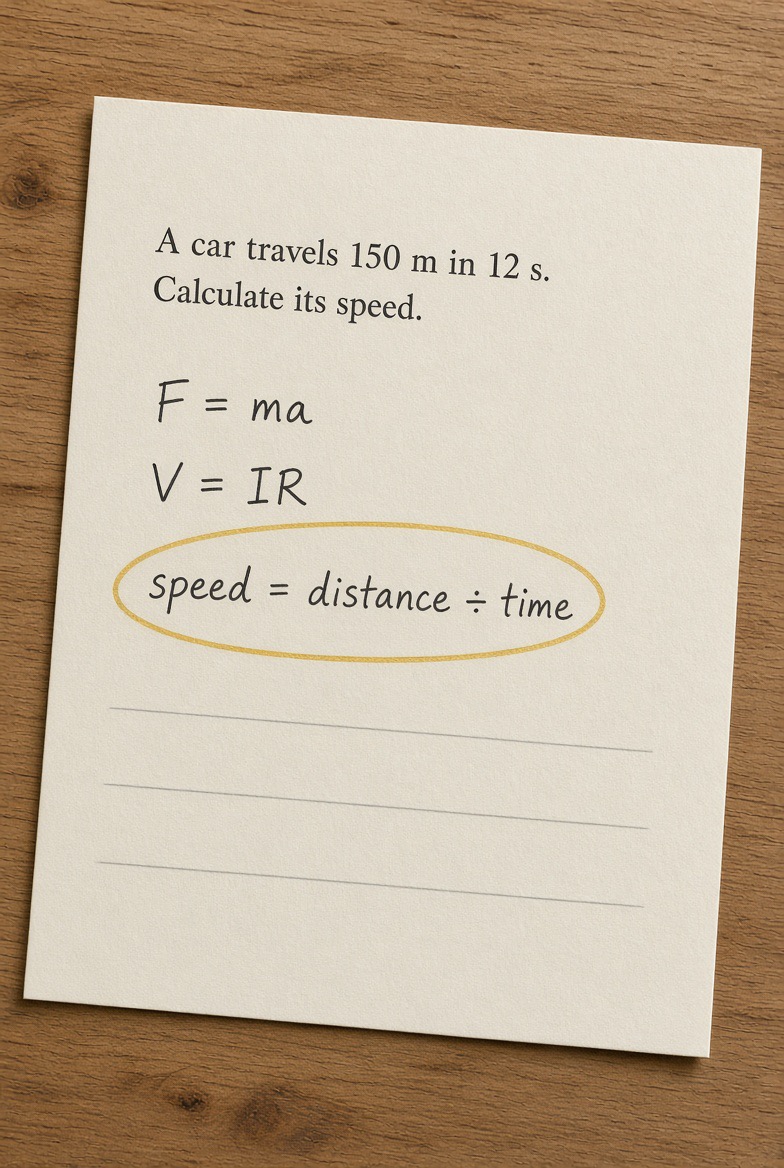
How to Revise GCSE Physics Effectively
GCSE Physics can become difficult when students try to memorise equations without understanding the physical ideas behind them.
Strong Physics performance requires several skills to work together: conceptual understanding, mathematical fluency, accurate units, graphs and data, practical reasoning and the ability to recognise which principle applies in an unfamiliar situation.
Effective revision should therefore connect the Science to the mathematics rather than treating them as separate tasks.
The goal is not simply to remember an equation. It is to know when it applies, what each quantity means and whether the final answer makes physical sense.
Quick Answer: What Is the Best Way to Revise GCSE Physics?
- Use the learner’s actual specification and course information.
- Diagnose weak topics from assessments before creating the timetable.
- Explain the physical concept before relying on an equation.
- Learn what quantities, symbols and units mean.
- Practise selecting and rearranging equations where required.
- Use diagrams, graphs and models to represent physical situations.
- Practise calculations in increasingly unfamiliar contexts.
- Revise practical and data-analysis skills.
- Mark errors by cause, repair them and retest later.
The Skinat Physics Revision Cycle
1. Understand: Can the learner explain the physical idea in words?
2. Represent: Can they use a diagram, graph, model or quantities to represent the situation?
3. Select: Can they identify the relevant principle, relationship or equation without being told?
4. Calculate: Can they substitute, rearrange and calculate accurately with appropriate units?
5. Interpret: Can they explain what the answer, graph or data means physically?
6. Apply: Can they use the same Physics in a changed or unfamiliar context?
7. Retest: Can they solve a different question later without the original support?
UNDERSTAND → REPRESENT → SELECT → CALCULATE → INTERPRET → APPLY → RETEST
1. Start With the Correct Physics Specification
GCSE and IGCSE Physics specifications differ in content, equations, practical requirements and assessment structure.
Combined Science and separate Physics courses may also differ in depth and coverage.
Use the learner’s school information and current specification as the source of truth before deciding what to revise.
2. Diagnose Before Revising Everything
Use mocks, topic tests, homework and teacher feedback to classify topics.
- Secure — can explain, calculate and apply independently.
- Developing — partial understanding with recurring mistakes.
- Priority — important concepts, equations or mathematical skills remain insecure.
Revision time should respond to these differences instead of giving every topic equal attention.
3. Understand the Physics Before Memorising the Equation
An equation is more useful when the learner understands the relationship it represents.
Before calculating, ask:
- What quantities are involved?
- What does each quantity mean physically?
- If one quantity increases, what should happen to another?
- What situation does this relationship describe?
- Would the expected answer be large, small, positive or otherwise constrained by the context?
This conceptual check makes it easier to detect unreasonable numerical answers.
4. Learn Symbols and Units Together
Physics calculations depend on accurate interpretation of quantities and units.
When revising an equation, learn the quantity, symbol and relevant unit together where required by the specification.
Practise recognising when values need converting before substitution. Unit errors should be logged separately from conceptual errors.
5. Practise Selecting the Equation
Students often succeed when the equation is supplied beside a worked example but struggle when several relationships are available.
Practise identifying:
- What information has been given?
- What quantity is required?
- Which relationship connects those quantities?
- Is rearrangement needed?
- Are the units compatible?

Equation selection is a reasoning skill, not just a memory test.
6. Separate Physics Errors From Maths Errors
A wrong answer may result from choosing the wrong physical relationship or from executing the mathematics incorrectly.
- Wrong principle or equation selected — Physics understanding/recognition issue.
- Correct equation but incorrect rearrangement — algebra issue.
- Correct setup but arithmetic error — calculation issue.
- Correct number but wrong unit — units issue.
- Correct calculation but implausible interpretation — checking/understanding issue.

Identifying the first point of failure makes revision more efficient.
7. Use Diagrams and Models
A simple diagram can make an abstract Physics problem easier to interpret.
Depending on the topic and course, useful representations may include force diagrams, ray diagrams, circuit diagrams, energy pathways, wave representations or labelled motion sketches.
The learner should be able to explain what the representation means rather than simply copy it.
8. Practise Graphs as Physical Stories
Graphs should not be treated only as shapes.
Ask what each axis represents, what a gradient or area means where relevant to the course, what changes across different regions and what physical process could produce the pattern.
Students should practise moving both ways: from a physical situation to a graph, and from a graph back to the physical interpretation.
9. Revise Practical Physics Through Reasoning
Practical revision should include understanding why measurements are taken and how evidence is evaluated.
- What is being changed?
- What is being measured?
- What needs to be controlled?
- Which instrument is appropriate?
- What affects uncertainty or reliability?
- What pattern should the data show?
- How could the method be improved?
The exact practical requirements should always be checked against the learner’s specification.
10. Move From Standard Calculations to Application
Do not stop when the learner can repeat a familiar worked example.
Use a progression:
- Direct concept question.
- Standard calculation.
- Equation selection without prompting.
- Changed context with unit conversion or additional information.
- Graph, practical or multi-step application.
- Unsignposted exam-style question.
This checks whether the learner can recognise the underlying Physics independently.
The Skinat Physics Transfer Check
- Can I explain the concept without an equation?
- Can I identify the quantities and units?
- Can I select the relationship myself?
- Can I rearrange and calculate accurately?
- Can I interpret what the answer means?
- Can I solve the same Physics when the context changes?
The first “no” identifies the next revision priority.
11. Use Past Papers to Diagnose, Not Just Score
After marking, classify each important error.
- Knowledge or concept gap.
- Wrong equation or relationship.
- Algebra/rearrangement error.
- Arithmetic error.
- Unit or conversion error.
- Graph/data interpretation.
- Practical reasoning.
- Application/transfer.
- Command-word or explanation error.
Repair the specific weakness and then use a different question to test whether it has improved.
A 30-Minute GCSE Physics Revision Block
- 5 minutes — closed-book concept and equation retrieval.
- 6 minutes — explain the concept and check units/relationships.
- 7 minutes — focused calculations or representations.
- 8 minutes — exam-style application questions.
- 3 minutes — mark and classify errors.
- 1 minute — record what needs retesting.
This is a flexible example rather than a universal timetable. Different learners and topics may require different session lengths.
Common GCSE Physics Revision Mistakes
- Memorising equations without understanding them.
- Learning equation symbols but not units.
- Practising only calculations where the equation is already given.
- Ignoring graphs and data interpretation.
- Avoiding algebra or unit conversion weaknesses.
- Copying practical methods without understanding their purpose.
- Completing past papers without analysing the cause of errors.
- Using materials that do not match the learner’s specification.
- Assuming every calculation error means the Physics is weak.
How Parents Can Support GCSE Physics Revision
- Ask your child to explain the physical idea before calculating.
- Ask what each quantity and unit means.
- Ask how they knew which equation to use.
- Encourage them to estimate whether an answer is reasonable.
- Use assessment evidence to identify priority topics.
- Check that revision includes graphs, practicals and application as well as equations.
- Encourage retesting after mistakes have been repaired.
When Might Additional Physics or Science Support Help?
Additional tuition may help when conceptual gaps, equation selection, mathematical skills or application difficulties persist despite school support and independent revision.
The teaching should identify whether the main barrier is Physics, Maths or the connection between them.
Learn More: How to Revise GCSE Science Effectively • How to Revise GCSE Biology Effectively • How to Revise GCSE Chemistry Effectively • How to Know If Your Child Needs a Science Tutor
How Skinat Tuition Supports GCSE Physics
Skinat Tuition provides personalised online Science tuition through qualified UK teachers.
For Physics, assessment evidence can help distinguish conceptual understanding, equation selection, mathematical execution, units, graphs, practical reasoning and application.
Our core approach is:
DIAGNOSE → TEACH → PRACTISE
Then we use changed questions to check whether the learner can apply the Physics independently.
Explore More: Primary Tuition • GCSE/IGCSE Tuition • Secondary Tuition • Programmes Hub
A UK-Wide Qualification Note
This article targets GCSE Physics search intent. GCSE, IGCSE, National 5 and other UK qualifications have different content and assessment requirements.
Revision materials and tuition should be aligned to the learner’s actual qualification, specification and educational context rather than assuming all UK Physics courses are interchangeable.
Frequently Asked Questions
What is the best way to revise GCSE Physics?
Combine conceptual explanation, equation and unit knowledge, calculation practice, diagrams, graphs, practical reasoning, application questions, error analysis and spaced retesting.
How do I remember GCSE Physics equations?
Learn what the quantities mean and how they relate, retrieve the equation from memory where your specification requires it, and practise selecting and applying it in varied contexts.
How can I get better at Physics calculations?
Identify the quantities, select the correct relationship, check units, rearrange where needed, calculate carefully and then decide whether the result makes physical sense.
What if I am bad at Maths but need GCSE Physics?
Identify the specific mathematical skills causing difficulty rather than treating “Maths” as one problem. Algebra, ratios, graphs, standard form or unit conversion may need targeted practice alongside the Physics.
How should I revise Physics practicals?
Understand variables, measurements, equipment, data, uncertainty and improvements at the level required by your actual course rather than memorising a method without meaning.
Are past papers the best way to revise Physics?
They are valuable for application and exam practice, but they work best when errors are analysed, repaired and retested. They should not replace teaching of insecure concepts.
Can Skinat Tuition help with GCSE Physics?
Yes, subject to appropriate teacher availability. Support can target the learner’s course and identified Physics or wider Science gaps.
Conclusion: Physics Revision Should Connect Understanding and Calculation
GCSE Physics is not simply a collection of equations.
Students need to understand the physical idea, represent the situation, select the relevant relationship, calculate accurately and interpret the result.
Use assessment evidence to identify the first point where that chain breaks, repair it and test the skill again in a changed context.
At Skinat Tuition, our qualified UK teachers use personalised teaching to help learners strengthen Physics understanding and apply it with increasing independence.
Your child’s first lesson is free, with no obligation to continue.
Discover more from Online Tutoring UK | Qualified Teachers | Skinat Tuition
Subscribe to get the latest posts sent to your email.