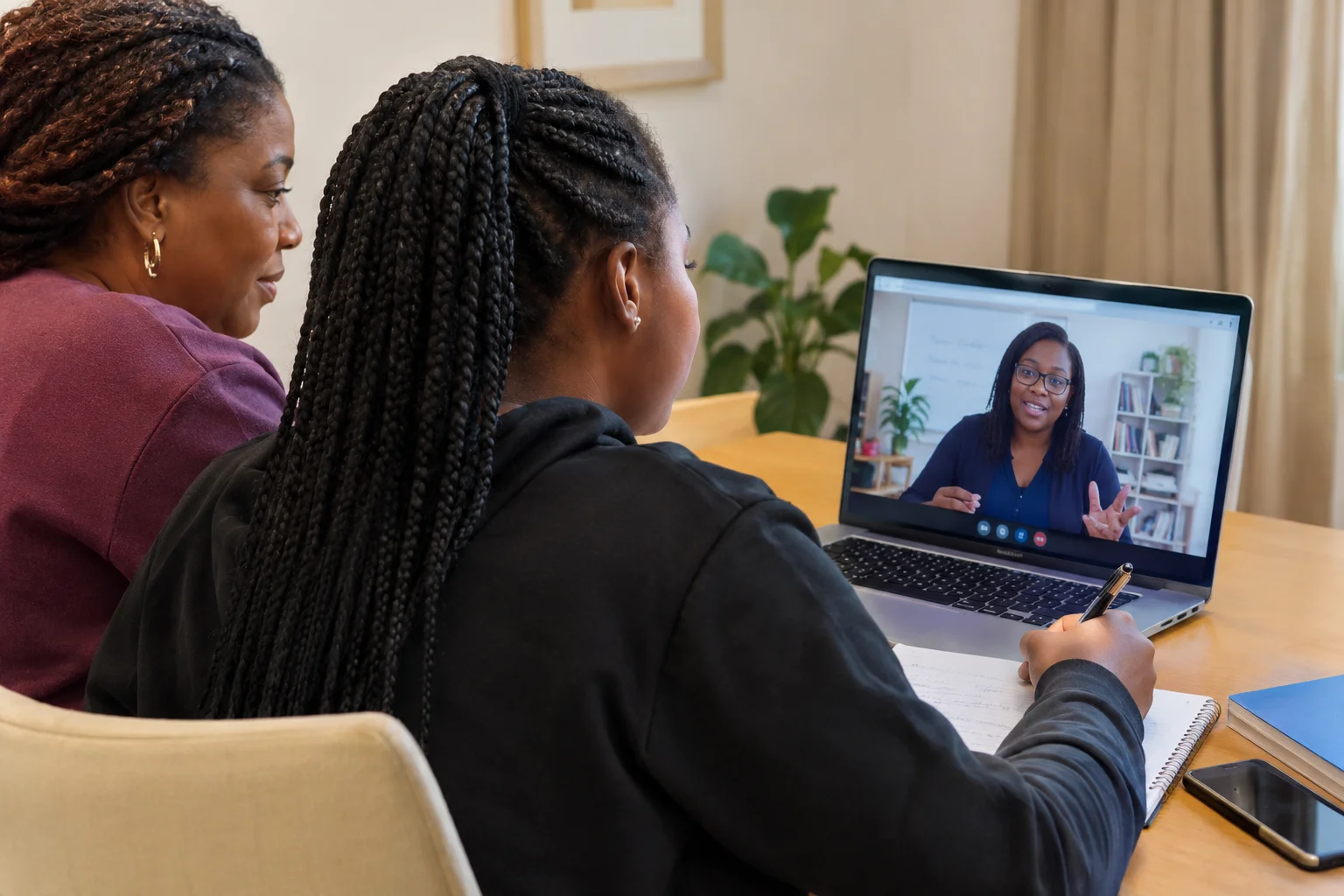
How to choose a GCSE tutor comes down to a handful of checks: whether they are qualified to teach, whether they know your child’s exam board and tier, whether they diagnose before they teach, and whether they can show you progress. Price and lesson format matter, but far less than these.
This guide from Skinat Tuition works across Maths, English and Science. It explains the seven questions to ask any tutor, the red flags to avoid, what tuition costs, and what a good first lesson should look like. If you only need Maths, our guide to choosing an online GCSE Maths tutor goes deeper.
Want to test a tutor before you commit? Book a free first lesson with Skinat Tuition and see how we work.
Quick Answer: How Do You Choose a Good GCSE Tutor?
To choose a good GCSE tutor, check that they are a qualified teacher, know your child’s subject, exam board and tier, begin with a diagnosis of where marks are lost, and report progress against specific skills. Compare the total monthly cost, not just the hourly rate, and use a free first lesson to judge fit.
Key points:
- Check teaching qualifications and GCSE experience.
- Confirm they know your child’s exam board and, for Maths, the tier.
- Look for a diagnosis before lessons start.
- Ask how progress is measured and shared.
- Compare monthly cost and what is included.
- Try a free first lesson before committing.
Why Is It Hard to Choose a GCSE Tutor?
Anyone can advertise as a tutor in the UK. There is no required qualification, no single price and no national register, so a student tutor, a graduate with no classroom training and an experienced teacher can all appear side by side in the same search results.
GCSEs are also graded from 9 to 1 and regulated by Ofqual, with different boards and qualifications across the UK. A tutor who is brilliant at one subject or board may not suit another. Parents are left comparing prices and reviews, which tell you little about whether teaching will actually raise marks.
When Should You Start Looking for a GCSE Tutor?
Earlier is usually easier, because gaps are simpler to repair before exams approach. Our guide on when to start GCSE revision explains how to plan, but as a rule:
- Year 9: secure foundations, often through KS3 tuition.
- Year 10: repair gaps steadily and build good revision habits.
- Year 11: target weak areas, exam technique and mock preparation.
Some signs it is time: grades below target, the same mistakes repeating, mock results lower than expected, or a child who understands lessons but cannot work alone. Each has a dedicated guide: why your child is struggling with GCSE Maths, Child understood maths but get low marks, poor mock results and Science grades not improving.
The Skinat Tuition 7-Question Check: How to Choose a GCSE Tutor

Use these seven questions to compare any tutor or tuition provider:
- Are they a qualified teacher?
- Do they know your child’s subject at GCSE level?
- Do they know your exam board?
- Do they diagnose before teaching?
- Is practice exam-style, with mistakes analysed?
- How will you see progress?
- What is the total cost, and what is included?
1. Are They a Qualified Teacher?
A qualified teacher knows common misconceptions, can explain an idea several ways, and understands how GCSE papers are marked. A tutor without classroom training may still be excellent, but you should ask about their background and how they were recruited.
At Skinat Tuition, lessons are delivered by qualified UK teachers. You can read about our teachers and our safeguarding approach before you book.
2. Do They Know Your Child's Subject at GCSE Level?
Being good at a subject is different from teaching a GCSE in it. A good tutor knows the specification, the command words and what examiners reward. This matters most in the three core subjects:
- Maths: they should understand Foundation and Higher tier. See GCSE Maths Foundation vs Higher and our guide to improving GCSE Maths grades.
- English: they should treat Language and Literature as separate qualifications. See Online GCSE English Tutor & GCSE English Language vs Literature.
- Science: they should know whether your child takes Combined or Triple Science. See Combined Science vs Triple Science.
3. Do They Know Your Exam Board?
Most students in England sit AQA, Pearson Edexcel or OCR. Students in Wales may take WJEC Eduqas, and students in Northern Ireland take CCEA. Scotland uses National 5, assessed by the SQA, which is a different qualification, not another name for GCSE.
Content overlaps, but boards differ in paper structure, question style and required formulae. Read our guide to GCSE exam boards, then check your tutor knows yours. Scottish families can see our guide to National 5 Maths tutoring.
Not sure which board your child sits? Ask us in a free first lesson with Skinat Tuition. We’ll match support to the right qualification.
4. Do They Diagnose Before They Teach?
A weak tutor asks, “What topic is your test on?” A strong one asks, “Which questions lost marks, and why?” Marks are usually lost for a small number of reasons:
- A missing skill from an earlier year
- A concept memorised but not understood
- A method that cannot be applied to an unfamiliar question
- Careless slips or misread questions
- Poor timing or unclear working
Each needs a different fix, and more worksheets will not repair a conceptual gap. If your child understands the work but still drops marks, read why a child good at Maths makes silly mistakes or why a child knows Science but loses marks in exams. Bring a recent paper to the first lesson, because it tells a tutor more than a conversation.
5. Is Practice Exam-Style, and Are Mistakes Analysed?
Redoing a corrected question proves recall, not understanding. Better lessons set a changed version of the question later, without prompts, to test whether the skill transfers. They also practise reading command words, showing method and managing time. Our guide on how to prepare for GCSE mock exams shows this in action, and our Science revision guides (Physics, Chemistry, Biology) show it by subject.
6. How Will You See Progress?
Grades move slowly and may not show early improvement. Better evidence includes topic-level results, fewer repeated errors and improved timed work. Ask how often progress is shared and who you can contact. Skinat Tuition sends parents progress updates, and you can see how lessons run on our how it works page.
7. What Is the Total Cost, and What Is Included?
Compare monthly cost, number of sessions, session length, and whether feedback and progress updates are included. We cover this fully in our guide to how much GCSE tutoring costs in the UK, but the short version is below.
How Much Does a GCSE Tutor Cost?
Published UK guides commonly put private GCSE tutoring at roughly £25 to £50 an hour, with student tutors at the lower end and experienced teachers higher. There is no official tariff, so a cheaper hourly rate is not always better value.
At Skinat Tuition, secondary small-group tuition starts from £120 per month and 1-to-1 secondary tuition from £160 per month, with a free first lesson. See current packages on our pricing page.
Want to compare options before deciding? Book a free first lesson with Skinat Tuition. There is no obligation to continue.
1-to-1 or Small-Group: Which Should You Choose?
One-to-one tuition follows your child’s exact gaps and pace. Small groups cost less and suit students whose needs match the group, but each child gets less individual time. The Education Endowment Foundation reviews research on both and finds tuition can add meaningful progress when it links closely to classroom learning.
Choose 1-to-1 if your child has large gaps, low confidence or a grade target. Choose a small group if the main need is regular structured practice. Skinat Tuition offers both through our secondary tuition programmes.
Online or In-Person: Which Should You Choose?
For most students, quality of teaching matters more than location. Online tuition widens your choice of teachers, removes travel and uses shared digital workspaces. In-person suits children who find screens hard. Skinat Tuition teaches students across England, Scotland, Wales and Northern Ireland, so location never limits the teacher you can work with. For subject-specific advice, see our guides to choosing an online GCSE Maths tutor, online GCSE English tutor and online GCSE Science tutor.
Red Flags When You Choose a GCSE Tutor
Be cautious if a tutor or provider:
- Guarantees a grade. No reputable tutor can.
- Starts teaching without asking about your child’s work or results.
- Cannot say which exam board or tier they have taught.
- Offers no way to see progress.
- Pushes you to commit to a long contract before trying a lesson.
- Prices only by hour, with no clarity on what else is included.
What Should Happen in a Free First Lesson?
A free first lesson should give you real information, not a sales pitch. Look for:
- Questions about school, recent results and your child’s own view
- A recent paper used to find where marks are lost
- A short piece of teaching on one real gap
- A clear recommendation and honesty about what is realistic
Afterwards, ask your child whether the explanation made sense and whether they felt comfortable asking questions.
Ready to try it? Book your free first lesson with Skinat Tuition and bring your child’s latest paper.
Choosing a GCSE Tutor for SEND, Home Education and Other Stages
Students with SEND may need slower pacing and varied explanations, which Skinat Tuition provides through SEND-friendly tuition. Exam access arrangements such as extra time are arranged through the school under JCQ rules, so speak to the school’s SENCo early. Home-educated students can use our home education support, and students continuing to A Level can move on to Post 16 tuition. If your child is younger, see our primary tuition.
How Skinat Tuition Helps You Choose and Start

Skinat Tuition provides online GCSE support in Maths, English and Science through qualified UK teachers, matched to each student’s qualification and exam board where relevant. Our approach is DIAGNOSE → TEACH → PRACTISE → RETEST. We find where marks are being lost, teach that gap, practise it in exam-style questions, and retest it later in a different context.
GCSE support sits within our GCSE and National 5 tuition. You can browse every stage on our programmes hub, read answers on our FAQ page or learn about Skinat Tuition.
Start with a free lesson. Book a free first lesson with Skinat Tuition and see our approach for yourself.
Explore More GCSE Guides From Skinat Tuition
Maths: Online GCSE Maths tutor · How to improve GCSE Maths grades · Why is my child struggling with GCSE Maths? · National 5 Maths tutor
GCSE Maths Foundation VS Higher. Child Understands GCSE Maths but Get low marks.
English and Science: Online GCSE English tutor · Online GCSE Science tutor · Does my child need a Science tutor? · My child is struggling with Science
Exams and planning: When to start GCSE revision · Mock exam preparation · After poor mock results · Exam boards explained
Other GCSE Articles:
How much does GCSE cost in the UK
How to prepare for GCSE Mock Exams
Frequently Asked Questions
How do I choose a GCSE tutor?
Check teaching qualifications, subject and exam-board knowledge, whether lessons begin with a diagnosis, how progress is reported and the total monthly cost. Use a free first lesson to judge fit.
What qualifications should a GCSE tutor have?
There is no legal requirement, but a qualified teacher with GCSE experience in your child’s subject is the safest choice. Ask about teaching background and recruitment.
How much does a GCSE tutor cost in the UK?
Published guides commonly cite around £25 to £50 an hour. Skinat Tuition’s secondary tuition starts from £120 a month for small groups and £160 a month for 1-to-1. Compare what is included, not just the price. see our guide on how much does gcse cost in the UK.
Is a 1-to-1 or group tutor better for GCSE?
1-to-1 suits large gaps, low confidence or grade targets. Small groups suit regular structured practice at a lower cost. Either can work when the teaching is diagnostic.
Should a GCSE tutor know my child’s exam board?
Yes. AQA, Pearson Edexcel, OCR, WJEC Eduqas and CCEA papers differ in structure and style, so a tutor who knows your board can prepare your child for the actual exam.
When should I start looking for a GCSE tutor?
Earlier is usually easier. Year 10 is a common start, though Year 9 and Year 11 can work well too.
Can a GCSE tutor guarantee a grade?
No reputable tutor can. Progress depends on the starting point, effort, time and consistency, so look for providers that track specific skills.
Is online GCSE tutoring as good as in-person?
It can be, when teaching is well qualified and targeted. Diagnosis, exam-style practice and follow-up matter more than location.
Does Skinat Tuition offer a free first lesson?
Yes. The first lesson is free, with no obligation to continue.
Conclusion: Choose the GCSE Tutor Who Finds the Real Gap
Knowing how to choose a GCSE tutor protects both your child’s time and your money. The best tutor is not the cheapest or the loudest advertiser. They are qualified, know your child’s subject and exam board, diagnose before teaching and show evidence of progress. Use the seven questions to compare options, bring a recent paper to the first lesson, and judge the tutor by how clearly they explain.
For subject-specific help, read our guide to choosing an online GCSE Maths tutor, then explore the English and Science guides.
Ready to see it in action? Book a free first lesson with Skinat Tuition, bring your child’s latest paper, and find out where the marks are going. There is no obligation to continue.
Discover more from Online Tutoring UK | Qualified Teachers | Skinat Tuition
Subscribe to get the latest posts sent to your email.